Tarot Card Meanings: Find a Card or Study Guide
Revised · Tarot card study and optional reflection
If you know the card’s name, open that card. If you only know its group or suit, use the matching collection. If your question concerns a picture, source or spread position, choose a method guide. This map organizes those routes; it does not require a draw or repeat all 78 card meanings.
Start from the question you actually have
On a narrow screen, scroll this table sideways to read all columns.
| Reader question | Matching destination | Purpose |
|---|---|---|
| “What does this named card mean?” | Full card lookup | Find its existing card page by name. |
| “Which cards belong to Major Arcana?” | Major Arcana collection | Browse the 22 named Major cards in the site’s deck system. |
| “Where are the Minor Arcana meanings?” | Minor Arcana collection | Browse the 56 suit cards rather than the Major group. |
| “How do I read a Minor card’s suit and rank?” | Minor Arcana learning guide | Separate classification, actual image and tentative interpretation. |
| “How do several cards work together?” | Spread interpretation guide | Connect cards to their assigned position jobs before writing a synthesis. |
| “A guidebook changed how I see the picture” | Source comparison exercise | Preserve the first description and add the source’s account separately. |
The full lookup contains the individual card destinations; this topic page helps you choose a route. No reading tool is needed to browse either. A known card name is already enough to start.
Browse by group or suit
In the system used by these collections, there are 22 Major cards and 56 Minor cards. The Minor group has four suits of fourteen: Ace through Ten, then Page, Knight, Queen and King. Waite’s historical Four Suits chapter describes that numbered-card and court structure. Use the contents and documentation of your own edition if it differs.
On a narrow screen, scroll this table sideways to read all columns.
| Collection | Cards linked here | Useful when |
|---|---|---|
| Major Arcana | 22 | You are finding a named Major card, such as the Magician or Empress. |
| Minor Arcana | 56 | You know the card belongs to a suit but want the full Minor directory. |
| Cups | 14 | The actual card’s suit label or emblem is Cups. |
| Wands | 14 | The actual card’s suit label or emblem is Wands. |
| Swords | 14 | The actual card’s suit label or emblem is Swords. |
| Pentacles | 14 | The actual card uses this suit’s name or documented equivalent. |
Major and Minor are card classifications. They do not establish how important an event is, when it will happen or whether it happened at all. A court card belongs to the Minor group; a person pictured on it is not proof of a particular person’s identity.
For the classification itself, read Major vs Minor Arcana. For the contents of a physical set, use the separate deck inventory checklist. A correct total can still conceal a duplicate and a missing card; inventory and interpretation are different tasks.
Worked lookup: Queen of Cups
Suppose the card in your hand says Queen of Cups. Use the full lookup, the Minor collection or the Cups collection to reach Queen of Cups. It is a Minor court card in this system, so opening the Major directory would not answer that lookup.
Record the actual deck and picture before comparing interpretations. If you associate the card with care or a thoughtful response, label that as an association. It does not verify another person’s feelings or establish that a particular woman is involved.
If Queen of Cups occupies an “action” position in a spread, ask how the interpretation could inform a proportionate response in the known situation. Do not silently change that position into “who secretly loves me.” The spread guide explains how to keep position jobs explicit.
Other named entry points retained here are the Sun, the Empress and the Magician. Open them when those are the cards you want to study, not because one must be drawn before you can use the directory.
Choose a method guide for a method question
A dictionary-like keyword, a source description and a position-specific interpretation answer different questions. Write which one you need before opening several pages.
- Suit study, with separate Cups, Wands, Swords and Pentacles guides.
- Court-card study and Page, Knight, Queen and King comparisons.
- Major-card study guide or the revised Minor-card study guide.
- Reversed-card interpretation context if you choose to use reversals.
- Strength and Justice numbering and image comparison for edition differences.
- Dramatic-image questions if a card’s name or scene worries you.
These links are study routes. Interpretive conventions vary, and a dramatic picture, reversal or suit does not establish a threat, diagnosis or hidden fact. For an unfamiliar name or edition, check the actual documentation rather than forcing it into a familiar card.
Separate historical accounts from your current use
A source may describe a particular picture and list several associations. For example, Waite’s Two of Pentacles account describes a dancing figure and an endless cord, with varied historical meanings. A modern prompt about planning two tasks is an optional use; it is not the whole historical account or evidence that two demands exist today.
The source comparison exercise helps retain that distinction. You can note a source’s account without adopting every association, and you can leave an image uninterpreted. This map does not claim one tradition or keyword fits every deck.
Keep optional contexts separate from lookup
The love interpretation topic and feelings topic are optional contexts, not ways to verify another person’s mind. The birth-card guide concerns a separate chosen convention; it does not identify the card already in your hand.
If you want a fresh selection, the daily tool or daily reading context is available. If you want to work with an existing daily card, the daily task map routes you to meaning examples or journal questions. Start another draw only because that is the task you choose, not as a condition of reading a meaning.
Find the card, then choose the study task
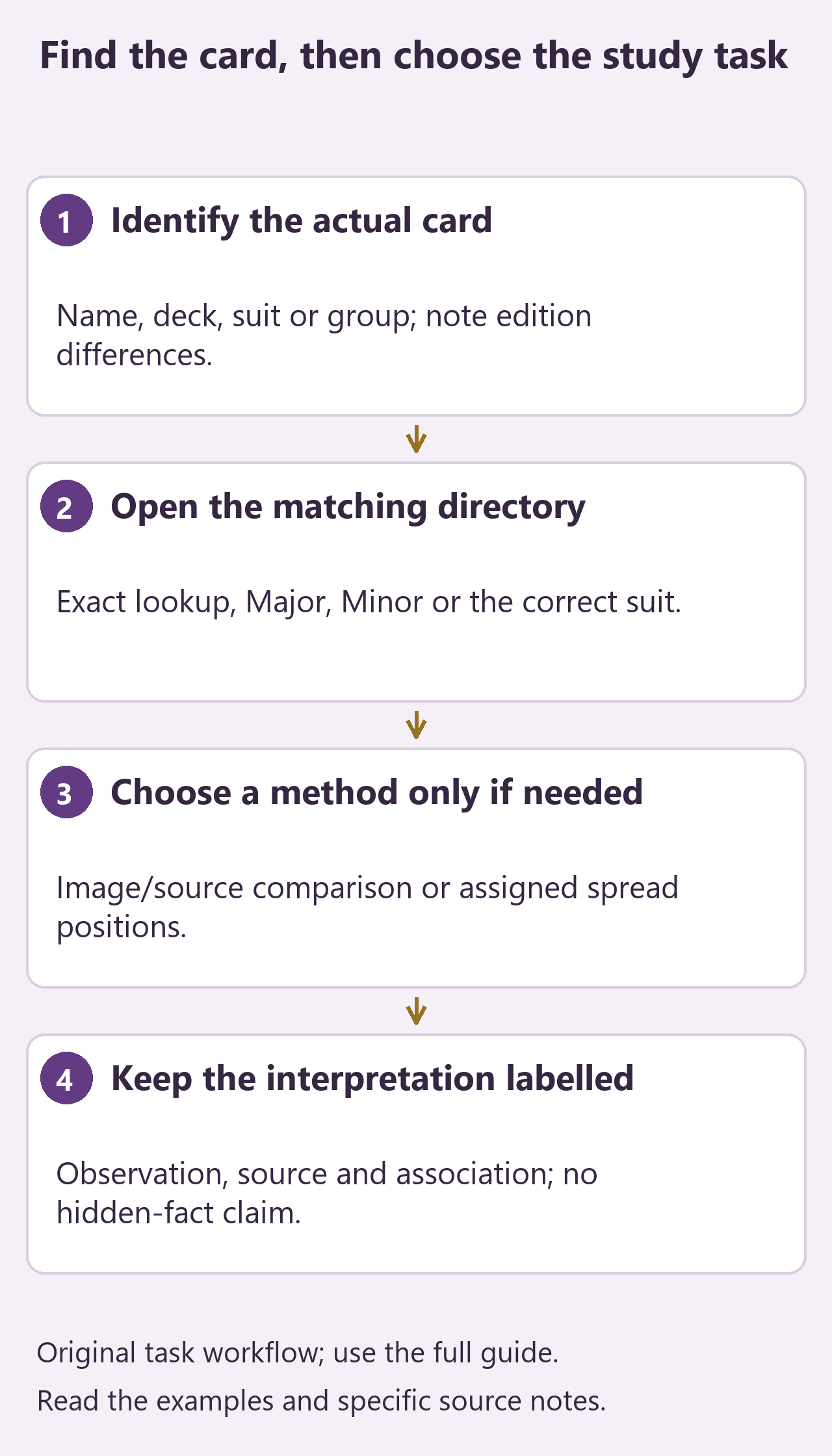
Examples to work through
These original examples show how to choose a proportionate task and keep actual information separate from an interpretation.
A Minor-card question opens Major Arcana
Use the Minor collection for suit cards, or the Minor learning guide for suit and rank. Queen of Cups belongs to the Minor group. The card’s classification does not depend on how important the reader feels the situation is.
The lookup is presented as a draw
Browse the named-card library directly. A new selection is optional and serves a different task. Labeling the lookup as a spread would obscure the route a reader with an existing card needs.
A keyword is treated as an established fact
Identify the image or source and label the association. A keyword cannot verify a person’s private feelings, a diagnosis or a future event. Use actual information for factual questions.
A different deck changes a name or picture
Record the edition and consult its documentation. Use a source comparison or the physical inventory checklist for that task. Do not assume a familiar keyword or total identifies every card in every set.
Card lookup and source-study note
Use these optional reminders to mark fields you want to keep in your own notes. The downloadable blank sheet contains every record field. Keep your completed record in your own appropriate private place.
Frequently asked questions
Do I need to draw a card before using the meanings library?
No. Open the existing lookup, group or suit collection directly. If you already have a card, use its actual name and deck rather than starting a fresh selection.
Where should I find Minor Arcana card meanings?
Use the Minor Arcana collection for all 56 suit-card destinations, a suit collection for its 14 cards, or the Minor learning guide for classification and image-reading distinctions.
Are court cards Major Arcana?
In the deck system used here, Page, Knight, Queen and King belong to the four Minor suits. The actual card and edition determine its identity, not how dramatic or important its picture feels.
Does a card meaning reveal somebody’s feelings or future events?
This map makes no such claim. Card meanings are interpretation routes and optional associations. Actual facts, another person’s statements and suitable advice remain separate sources of information.
Sources and what they support
- A. E. Waite: The Pictorial Key to the Tarot, The Four Suits
Supports the attributed historical account of numbered suit cards and court cards in this deck structure. It does not establish that every edition has identical names, contents or pictures.
- A. E. Waite: Two of Pentacles
Supports the attributed dancing figure, two pentacles and endless cord, with varied historical associations. Modern task-planning prompts are labelled as original optional uses, not the entire historical account or evidence of present circumstances.
The worked scenarios and writing tasks are original illustrations, not reader interviews, measured benefits or predictions. Keep the actual card image, an identified source account and your own association separate. The sources support only the specific points described above; an interpretive example does not establish hidden facts or professional advice.