Daily Tarot: Read, Look Up or Journal
Revised · Tarot card study and optional reflection
Start with what you want to do. An existing card needs a lookup or meaning example; a first practice needs a short setup; a journal question needs a prompt library. This daily tarot map links those separate tasks without making a fresh draw the answer to every question.
Choose the page that matches your task
On a narrow screen, scroll this table sideways to read all columns.
| What you have or need | Matching next page | What it helps you do |
|---|---|---|
| A card already selected | Exact card lookup | Find that card by its name and open its existing meaning page. |
| A practical card-of-the-day interpretation | One-card meaning examples | Separate an optional focus, a proportionate caution and a self-chosen action. |
| A first short daily practice | Daily reading routine | Set context, select one card, make a brief note and finish. |
| A question to write about | 21 daily journal prompts | Choose one useful question and keep a first note separate from a later review. |
| A complete multi-card reading to record | Full reading log | Record the question, positions, interpretation, synthesis and a dated addition. |
| The same card appears again | Repeated-card probability guide | Define the selection model and event without inventing a cause from a repeat. |
These are choices of task, not stages everyone must complete. You can arrive with a physical card, a previously selected image or a written observation and leave after finding the one page you need.
If you want a new reading
The daily tarot tool offers a topic and One card or Three cards. Its starting button is Draw Daily Cards. Choose One card for the short routine; Three cards is a different-sized practice. There is no required personal-question field in this tool, so put a written question in your own note if useful.
Use a real ordinary circumstance as the context. A draw can provide an optional image to reflect on; it cannot verify someone else’s feelings, authorize a consequential decision or guarantee the day’s events. If you already have a card, use its name rather than starting another draw just to reach a meaning page.
The one-card guide is another method resource. The daily advice page and daily card reading page are optional reading contexts, not substitutes for an exact-card lookup or the journal question library.
If you want to understand an image
Identify the actual card and deck. For example, existing pages for the Sun, the Star and Temperance are named-card destinations. They are available study examples; you do not have to draw any of them first.
Distinguish three things: a detail you can see, a description in an identified source and your own association. If a guidebook changes your interpretation, the before-and-after source exercise keeps both notes visible. For edition or image differences, use the Strength and Justice comparison.
A different task is checking the contents of a physical deck. The 78-card inventory checklist records identities, duplicates and edition differences. Counting the cards does not interpret today’s picture. The card-study map organizes the lookup and method pages.
Worked route: the card is already in your notebook
Imagine you noted Four of Swords yesterday and now want a short entry about an unfinished draft. You do not need another reading. Open the Four of Swords page if you want to study that card, or the daily meaning examples if you want an optional practical interpretation.
For a writing question, choose question 16 in the daily prompt library: whether a suitable pause would help more than further analysis. Check the actual deadline before choosing a response. Your known draft and timing provide the facts; the card does not diagnose fatigue or decide what is urgent.
If you later finish a paragraph, add a dated note about that action. If you do not, retain the unfinished task and consider the actual obstacle. The example illustrates choosing matching pages, not a measured outcome or a prediction.
Optional routines and reflection frames
Browse these only if their task fits. They are not requirements for a daily reading, medical care or proof that a calendar phase causes an emotion.
- How the site frames tarot as self-reflection.
- Morning routine or weekly planning spread for a different time frame.
- Optional self-care reflection or gentle present-day questions for a suitable voluntary writing task.
- Full-moon reflection frame or new-moon intention frame. Treat these as chosen ways to organize a note, not evidence about health, mood or future events.
The beginner topic offers another entry point. The feelings topic is a separate interpretation context; a card cannot confirm somebody’s private feelings.
Keep a repeat separate from a life-message explanation
A repeated card is an outcome in a selection record. Its probability depends on the eligible cards, replacement and assumptions about the procedure. In an independent model, a previous outcome does not make a card due or show that an action was missed. OpenStax discusses these independence distinctions; it does not audit this site’s draws or your mixing.
You may voluntarily revisit an image or review an action you actually took. That is a choice of reflection task, not a meaning established by the repeat. Use the probability resource for mathematics and the journal page for a dated action review.
If the practice expands into repeated checking for a reassuring answer, stop and return to actual information or suitable support. You can use the directory, keep a note or skip the exercise without completing a reading.
Match the daily question to its destination
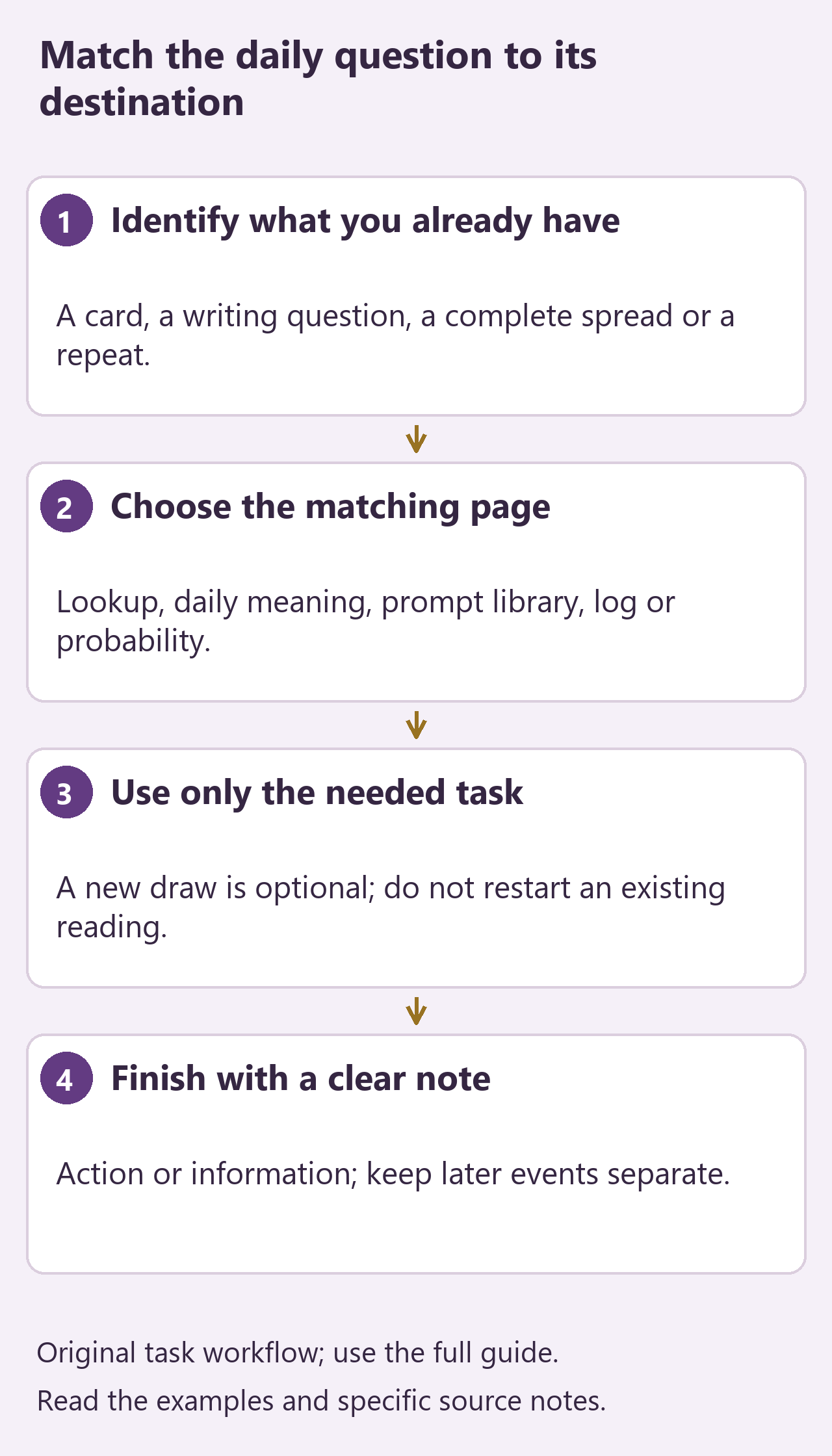
Examples to work through
These original examples show how to choose a proportionate task and keep actual information separate from an interpretation.
A daily journal search leads to a draw
Choose the 21-question library instead. It supports a short note with an existing card or no card. A new shuffle is not necessary to answer the request for a writing prompt.
A reader already knows the card name
Open the exact lookup or named-card page. For a practical daily interpretation, use the card-of-the-day examples. Starting another reading would add a different task rather than identify the existing card.
The notebook contains a full spread
Use the complete reading log for positions and a synthesis. The daily question library is smaller; choose it when a brief question and dated review are sufficient.
The reader asks why a card repeated
Use the probability guide to define the selection event and assumptions. Keep any voluntary image reflection separate. Repetition alone does not establish an external message, a missed action or a future event.
Daily tarot page-choice note
Use these optional reminders to mark fields you want to keep in your own notes. The downloadable blank sheet contains every record field. Keep your completed record in your own appropriate private place.
Frequently asked questions
Where should I start if I already have today’s tarot card?
Use the exact-card lookup to find its page or the one-card meaning examples for an optional practical interpretation. You do not need a new draw to use either.
Where are the daily tarot journal questions?
The 21 daily journal prompts page supplies a question library and a short dated log. It works with an existing card, a deliberately chosen image or no card.
Do I need the tool to use the daily tarot guides?
No. The tool is an optional way to select a card. The lookup, source comparison, prompt library and completed-reading log can be used independently.
Does the same card appearing again mean I missed a lesson?
That cause is not established by a repeat. Define the selection model for a probability question and review an actual action separately if useful. Reflection remains voluntary.
Sources and what they support
- OpenStax: independent and mutually exclusive events
Supports the general probability distinction between independence and replacement under stated assumptions. The explanations here use original wording; no textbook exercise or distinctive worked example is reproduced. The source does not audit this site’s selection procedure.
The worked scenarios and writing tasks are original illustrations, not reader interviews, measured benefits or predictions. Keep the actual card image, an identified source account and your own association separate. The sources support only the specific points described above; an interpretive example does not establish hidden facts or professional advice.