Tarot Card of the Day Meaning: Practical Examples
Revised · Tarot card study and optional reflection
A tarot card of the day can be an image you choose to reflect on, rather than a forecast of the day. Identify the actual card and deck, consider a tentative association in your known circumstances, and choose one proportionate action. One card does not explain every event.
Start with the card you already have
Write its name, deck and orientation. Look at the actual picture or read a source that identifies that deck. An image detail, a source’s traditional meaning and your own association are different things. Keep them separate before turning any of them into a daily suggestion.
You do not need another draw to use this page. If you have not selected a card and want a short setup, the daily reading routine covers that task. For an exact name, open the card lookup. This guide shows what to do with one existing card, not how to make a complete multi-card log.
Use three lines: focus, caution and action
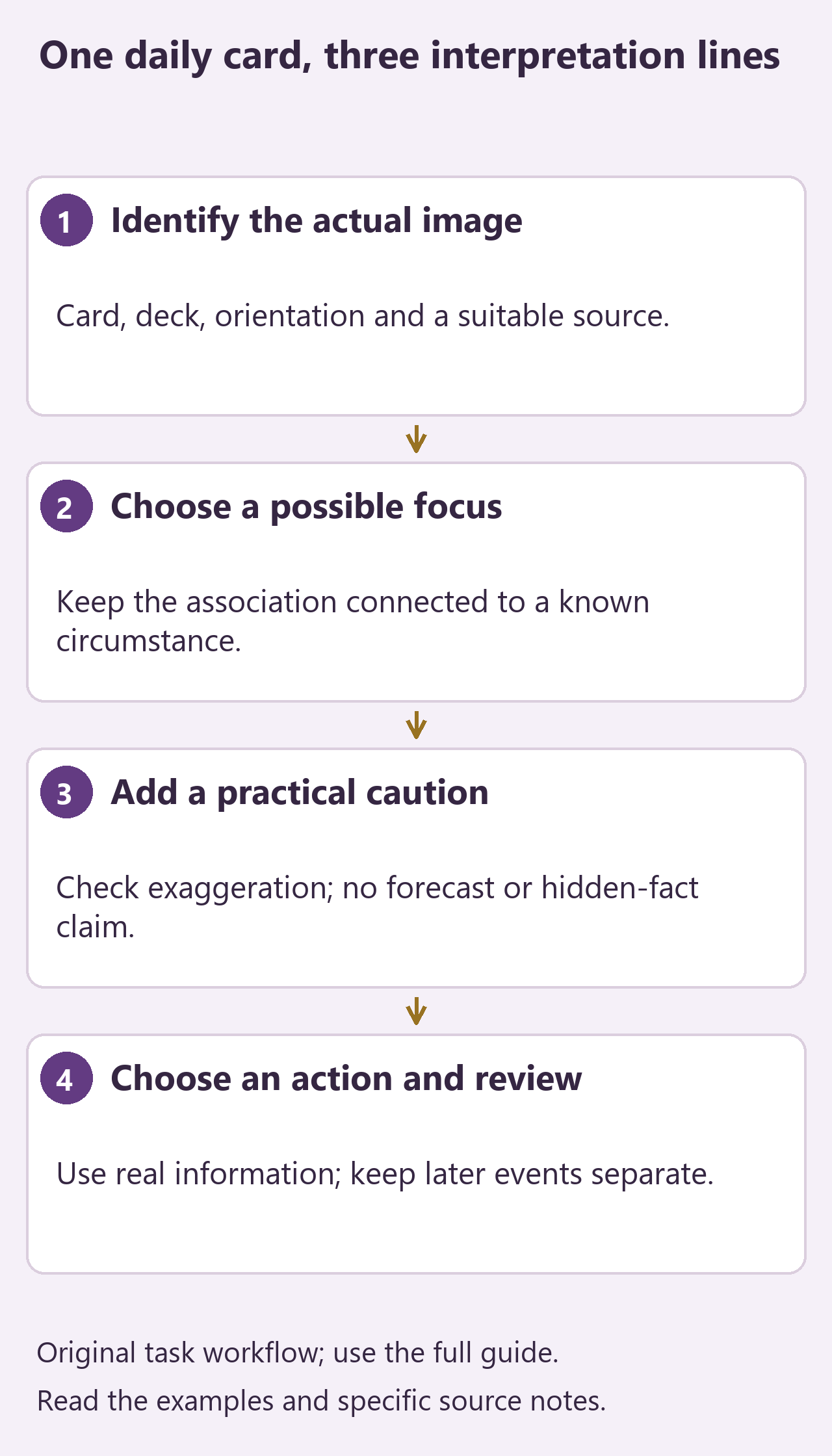
For focus, ask what association you would like to consider in today’s actual circumstances. For caution, ask how that association could be stretched or misused. For action, choose a small behavior that would be sensible even without the card. You may decide that the image does not help today.
On a narrow screen, scroll this table sideways to read all columns.
| Line | Useful wording | What to avoid |
|---|---|---|
| Focus | “I associate this image with clear communication; I have an update to write.” | “The card proves everybody will understand me.” |
| Caution | “I should not confuse being clear with disclosing more than is appropriate.” | “The picture warns that a specific bad event must happen.” |
| Action | “I will check the update’s first sentence and remove one vague phrase.” | “I must make a consequential decision because of this card.” |
The three lines are one interpretation, not three additional cards. The caution is your practical check, not a threat delivered by the picture.
Worked daily examples
These are invented scenarios using optional associations, not reader outcomes or universal card meanings. In each one, the actual task or feeling is stated before the interpretation.
On a narrow screen, scroll this table sideways to read all columns.
| Already selected card and known context | Possible focus and caution | A self-chosen action |
|---|---|---|
| The Sun; a short project update is due. | Consider clarity. Do not assume that openness requires sharing every detail. | Write the main point plainly and check what the audience needs. |
| Four of Swords; you have spent the morning editing the same page. | Consider a pause. Do not use the association to ignore an actual urgent responsibility. | Take a suitable break or set a realistic stopping point, using the real task demands. |
| Five of Cups; you already feel disappointed by a missed opportunity. | Acknowledge disappointment while noticing support that actually exists. Do not predict that the whole day will be sad. | Write the known loss and one available support or next step separately. |
| Two of Pentacles; two ordinary tasks need planning. | Consider how to handle competing demands. Do not infer a financial event from the card. | Check the deadlines and choose a feasible order. |
For the last example, Waite describes a dancing figure holding two pentacles linked by an endless cord. His historical meanings include gaiety and several kinds of agitation or written messages; they are not simply our modern task-planning sentence. The “competing demands” prompt is an original association. Use the chapter to identify its account, not to treat it as evidence of today’s events.
What if the card is difficult or reversed?
A name or dramatic image does not mean you are going to have a bad day. Describe your reaction before deciding whether you want to continue. You can use the image for a modest question, study its source another time or stop. You do not have to force a comforting meaning.
Reversals are optional conventions. Record the orientation you have and the method you chose. A reversed daily card does not automatically establish danger, delay or a blocked part of your life. If comparing upright and reversed associations helps, label it as a comparison of interpretations rather than a diagnosis.
For a specific image question, use the source comparison exercise. It keeps the initial note separate from what a book later adds. It does not require redrawing an image you dislike.
A repeated card does not explain its own cause
Repeats can occur in a random selection process. A repeated card or suit does not establish that life is asking you to practise a particular lesson. You may voluntarily revisit an image association, but say that it is your choice.
The probability depends on what could be selected, whether cards were returned, and whether the outcomes are equally likely and independent. OpenStax distinguishes replacement and independence in fair, well-shuffled examples; that is a mathematical model, not an audit of your deck or this tool. The repeated-card guide explains the separate probability questions.
End with a brief later note
At a time that suits your task, add what you did and what you observed. “I made the update clearer” describes an action. “The Sun correctly predicted the meeting” is a different claim that this exercise does not establish. Keep parts that did not fit, and do not rewrite the first interpretation to match every event.
The daily prompt library supplies a reusable short log if you want one. No streak, favorable card or completed worksheet is necessary to make ordinary choices. Stop if the process turns into repeated checking for reassurance.
One daily card, three interpretation lines
Examples to work through
These original examples show how to choose a proportionate task and keep actual information separate from an interpretation.
The Sun becomes a guarantee
A reader has a presentation and treats the Sun as proof that it will go well. Keep clarity as an optional preparation prompt, then check the actual material and audience. A useful rehearsal is an action, not evidence that the card predicts the result.
Five of Cups defines the whole day
The reader already feels disappointed and interprets the card as “today will be sad.” The feeling is real; the forecast is not established. Write the known situation and consider support that actually exists. You may also leave the image alone.
A reversed card feels like a warning
The orientation is observable, but a predicted harm is an interpretation. Record the reversal convention if you use one. You can study the image or choose a modest practical question without turning it into a danger forecast.
A repeat is treated as a required lesson
The same suit appears twice and the reader assumes they failed to act yesterday. That frequency does not establish a cause. Keep the draw record separate from any voluntary reflection about an actual action; do not redraw to obtain permission to continue the day.
One-card daily meaning note
Use these optional reminders to mark fields you want to keep in your own notes. The downloadable blank sheet contains every record field. Keep your completed record in your own appropriate private place.
Frequently asked questions
Does a tarot card of the day predict every event?
No such claim is made. This guide uses one card as an optional image prompt in known circumstances. The focus, caution and action are your interpretations and choices, not a forecast.
Should I draw again if I dislike the daily card?
You do not need to. You can acknowledge the reaction, look up the actual image, choose a proportionate prompt or stop. Another draw cannot make a feared event true or false.
What does a repeated daily card mean?
It is a repeated outcome in your selection record. Its probability depends on the procedure. It does not establish a missed lesson, an external message or a future event; an image association remains optional.
How do I make the meaning practical?
State one known circumstance, one tentative association and a sensible small action. Check the action using real information. If the association adds nothing, say so rather than forcing it to fit.
Sources and what they support
- A. E. Waite: Two of Pentacles
Supports the attributed dancing figure, two pentacles and endless cord, with varied historical associations. Modern task-planning prompts are labelled as original optional uses, not the entire historical account or evidence of present circumstances.
- OpenStax: independent and mutually exclusive events
Supports the general probability distinction between independence and replacement under stated assumptions. The explanations here use original wording; no textbook exercise or distinctive worked example is reproduced. The source does not audit this site’s selection procedure.
The worked scenarios and writing tasks are original illustrations, not reader interviews, measured benefits or predictions. Keep the actual card image, an identified source account and your own association separate. The sources support only the specific points described above; an interpretive example does not establish hidden facts or professional advice.