Daily Tarot Reading Guide: A Five-Minute Routine
Revised · Tarot card study and optional reflection
For a short daily tarot practice, name one ordinary circumstance, select one card, note an image or association and choose a small response you can assess using real information. Finish the reading before adding more cards. Five minutes is a suggested size, not a required ritual or a promise of benefit.
Choose a question that fits an ordinary day
Write what is already happening: an update to prepare, a conversation to approach or a small task to finish. Then choose a voluntary prompt such as “What would I like to pay attention to in this task?” Keep the answer about your own choices. A card cannot verify somebody else’s thoughts or guarantee an outcome.
You can do this on paper with a deck, a deliberately selected image or the site tool. State which method you use. Deliberate selection and random drawing are different procedures, but either can supply an image for an optional reflection. Neither turns the interpretation into an external fact.
Use the daily tool’s actual settings
The daily tarot tool asks for a topic and spread size. Its topics include General, Love, Career reflection and Personal growth. Choose One card for this routine. The starting button is Draw Daily Cards. No written personal question is required by this tool; your own note can hold the ordinary question you chose.
Read the returned card and any reflection text as suggestions to assess, not instructions you must follow. The tool also offers Three cards, which is a different-sized practice. You do not need to switch to it just because one card leaves a question unresolved. The spread interpretation guide covers multiple position jobs.
If you already have today’s card, go directly to the one-card meaning examples. You can finish with the same image instead of creating a new shuffle.
A short routine you can repeat or skip
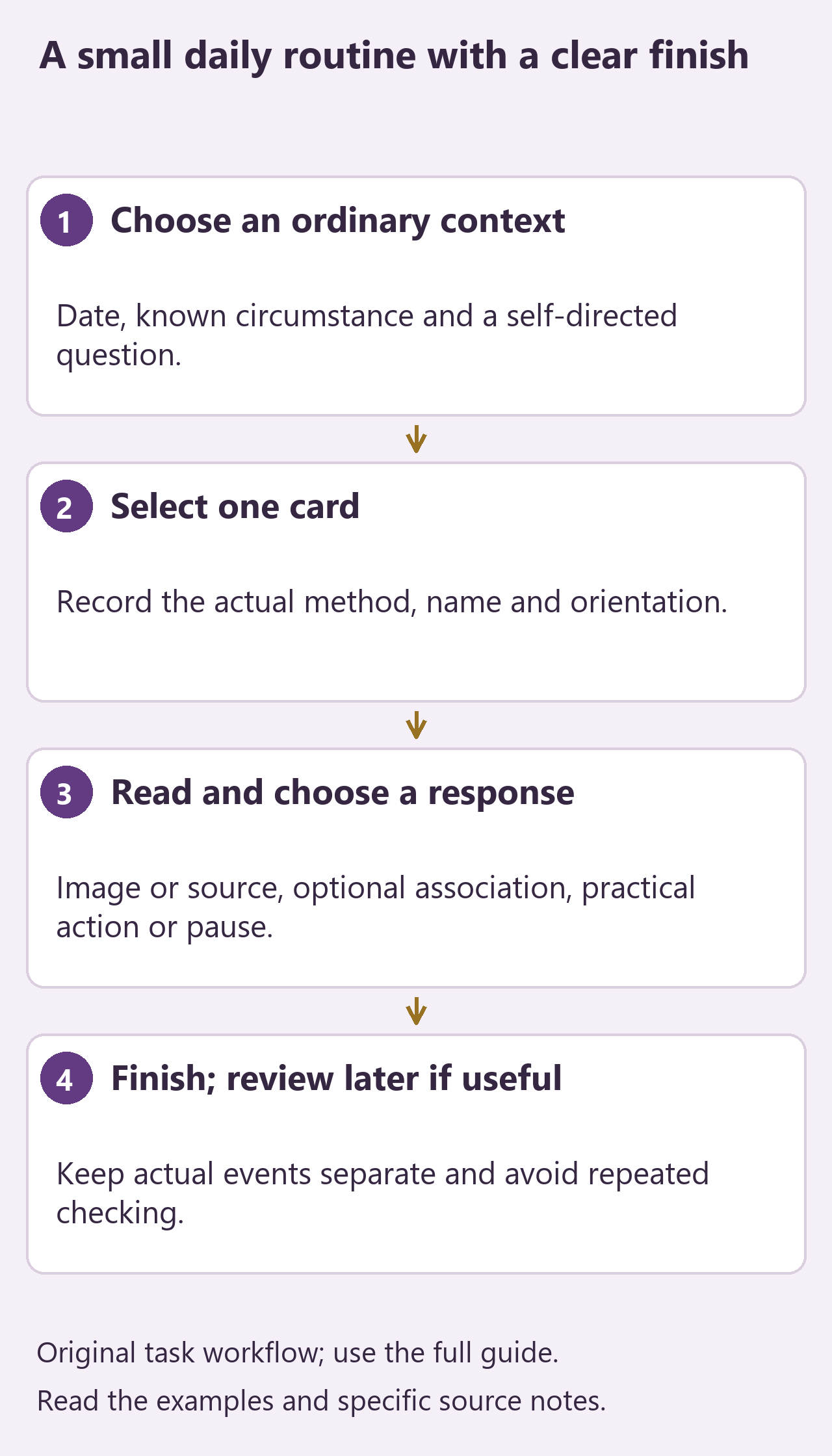
- Set the context. Write the date, one known circumstance and the question. Choose the deck or tool and any orientation convention.
- Select one card. Record its actual name and orientation. If you choose it deliberately, say so; do not report it as a random draw.
- Read a small amount. Note one visible detail or clearly attributed source description, then your own association. If needed, look up that exact card rather than browsing unrelated meanings.
- Choose and finish. Propose one sensible small response or a pause, using actual circumstances. Add a later review time only if it is useful.
A five-minute limit is one way to keep the task small. A shorter note, an occasional practice or no reading today can also suit you. There is no required streak, score or special favorable card that makes the day safe to begin.
Worked example: an ordinary tense message
Imagine you already have a message requiring a reply, and you feel irritated. You deliberately choose Strength for an illustrative practice. Those circumstances and the card choice are stated in advance; the image did not reveal them.
Your association is a calm response rather than a show of toughness. A note could be: “I feel irritated about the message. I associate this card with responding steadily. I will draft a short factual reply, check that it answers the request, and send it when appropriate.” This is an original optional use, not a universal rule for every Strength image.
A later addition might say: “I shortened the draft and removed a character judgment. The recipient clarified the missing detail.” Keep the actual exchange separate from the initial association. If the response did not help, record that too. A completed action does not prove that the card caused it or predicted the reply.
What if the card repeats?
Record what actually repeated and how the card was selected. A repeat does not establish that yesterday’s practice failed to move into behavior. The earlier action is a separate fact to review; the card frequency does not diagnose it.
In a uniform independent model with replacement, earlier draws do not make a particular card due or prevent a repeat. OpenStax explains independence and replacement with fair, well-shuffled examples; NIST describes fixed-probability success-count models. Neither certifies your physical mixing or this tool’s selection behavior from a short history.
The repeat-probability resource distinguishes events and procedures. Use it for that mathematical question rather than inventing a life-message explanation for the repeat. You may choose to study the same image again without treating it as an obligation.
Keep the practice from expanding into checking
If one card is unfamiliar, look up its actual name or a suitable source. If a real deadline, requirement or person’s availability is unknown, seek that information directly. A clarifier cannot verify it. If the reading increases worry or a need to obtain a comforting result, stop the exercise.
Choose a later note that fits the task: what you did, what information appeared and what did not fit your first interpretation. The daily prompt library supplies the separate recording task; you do not need to answer every prompt.
Use ordinary information and appropriate support for health, money, legal, employment and safety decisions. Tarot here is optional reflection. Starting, skipping or stopping a reading does not determine your ability to handle the day.
A small daily routine with a clear finish
Examples to work through
These original examples show how to choose a proportionate task and keep actual information separate from an interpretation.
The reader has only a short break
Choose a small ordinary question, one card and one note. You can also skip the reading. A short practice does not require a complete deck study, a second spread or a daily streak.
The same card appears again
Keep the outcome and selection procedure in the record. Review any actual action separately. The repeat does not establish that you missed a lesson, that the tool is fair or that a particular event is coming.
The question is a lifetime forecast
“Will my entire career succeed?” does not fit a small daily prompt. A question about preparing a particular task is narrower. Consequential career decisions still need real information; shrinking the wording does not give cards predictive powers.
A clarifier is being used to verify a fact
A reader wants another card to confirm when a meeting starts. Check the invitation or ask the organizer. The uncertainty is factual, and another draw cannot settle it. Finish or pause the reflection without manufacturing a time.
Short daily reading routine
Use these optional reminders to mark fields you want to keep in your own notes. The downloadable blank sheet contains every record field. Keep your completed record in your own appropriate private place.
Frequently asked questions
Is one card enough for a daily tarot practice?
It is enough for the optional routine on this page. You can make a short note from one image or skip the reading. More cards are not required to authorize an ordinary action.
What should I select in the site’s daily tool?
Choose a suitable topic and One card, then use Draw Daily Cards. The tool asks for those settings; a personal written question is optional in your own note. Its Three cards setting is a separate practice.
Do I have to do this every morning?
No. Five minutes and a daily rhythm are suggestions, not requirements or therapeutic prescriptions. An occasional practice or no reading can fit your circumstances.
What should I write after the reading?
Record the actual card, a known circumstance, your tentative association and an action or pause you choose. Add later events separately if you review it. A match does not establish a prediction, and a mismatch can remain visible.
Sources and what they support
- OpenStax: independent and mutually exclusive events
Supports the general probability distinction between independence and replacement under stated assumptions. The explanations here use original wording; no textbook exercise or distinctive worked example is reproduced. The source does not audit this site’s selection procedure.
- NIST: binomial distribution
Supports the mathematical model for a count of independent trials with a fixed success probability. It does not certify a tarot shuffle, app, interpretation or personal outcome.
The worked scenarios and writing tasks are original illustrations, not reader interviews, measured benefits or predictions. Keep the actual card image, an identified source account and your own association separate. The sources support only the specific points described above; an interpretive example does not establish hidden facts or professional advice.