Practical guide
Drawing the Same Tarot Card Repeatedly: Probability and Journaling
Define the event and selection procedure before assigning a chance. A known-card next match, a named-card sequence and any repeat in a longer window are different questions. Keep all outcomes separate from interpretation.
First define what “the same card again” means
Drawing the same tarot card repeatedly can happen in a random process. To ask how likely it is, first specify the event: the next card matching the last one, three consecutive cards all matching, a named card appearing twice, or any repeated identity in a week’s record. Those questions have different answers.
Under a model with 78 equally likely distinct card identities, independent draws and replacement before each draw, the next card has a 1 in 78 chance of matching the card already drawn. That is about 1.28%. It is not the probability that a particular named card appears in both of two draws planned before either occurs; that is 1 in 6,084.
The number 78 here is an explicit example assumption. Count the identities available in your own process and check how cards are selected. These calculations do not measure your shuffle, this website’s drawing tools or another app’s randomness. A probability model is useful only when its assumptions fit the question.
A repeat does not establish a warning, prediction, missed lesson or another person’s thoughts. You can use an image as an optional reflection prompt while keeping the observation—what was drawn—separate from your interpretation. There is no obligation to keep drawing until the result changes.
Check replacement, independence and card identity
OpenStax’s section on independent events explains that knowing one outcome does not change another outcome’s probability when the events are independent. Its card examples distinguish returning a card and reshuffling from putting it aside. The examples use a fair, well-shuffled playing-card deck; they do not test tarot procedures.
For this guide’s replacement model, each draw starts with the same N distinct identities, each has probability 1/N, and earlier draws do not change those probabilities. Returning a card is necessary to make that identity available again; it is not evidence that your actual mixing method meets the other assumptions.
| Decision | What to record | Why it changes the question |
|---|---|---|
| Card identity | Decide whether orientation counts. | Tower upright and Tower reversed are the same identity if orientation is ignored. |
| Available identities N | Count what could actually be selected. | A limited selection or extra duplicate card changes the sample space. |
| Replacement | Is the drawn card returned before the next draw? | A single block without replacement cannot repeat a unique physical identity. |
| Selection model | Are choices equally likely and independent? | Replacement allows repeats; it does not prove a real shuffle or app is uniform. |
| Event and window | Choose the event and number of draws before comparing probabilities. | Any repeat among seven draws differs from three consecutive matches. |
| Complete record | Include every draw in the stated window. | Extra clarifiers or discarded results are still draws, not invisible attempts. |
If the pool has one physical copy of each identity and you draw without replacement in one session, a repeated identity in that block is impossible. A matching name in a later session may be possible if you returned the cards between sessions. Do not combine those two procedures into one independent-draw record without explaining the reset.
Some decks, apps or deliberate selections may include duplicates, restricted choices or nonrandom rules. If you do not know the process, write “unknown” instead of treating 1/N as a measured chance. A short list of past outcomes cannot certify that an app or shuffle is fair.
Counting orientation separately needs a separate assumption. For instance, N card identities plus independent equally likely upright/reversed orientation would give 2N equally likely identity-and-orientation outcomes. Physical handling does not automatically make that true. Keep orientation as a separate log field unless you deliberately define and justify the expanded model.
Six probability questions that should not be swapped
The formulas below all use the same uniform independent replacement model. N is the number of possible distinct identities; m is the number of draws in the chosen window. For the “all matching” questions, the draws must be the specific block you defined, not a run you picked after scanning a much longer history.
| Event defined in advance | Probability | Reason |
|---|---|---|
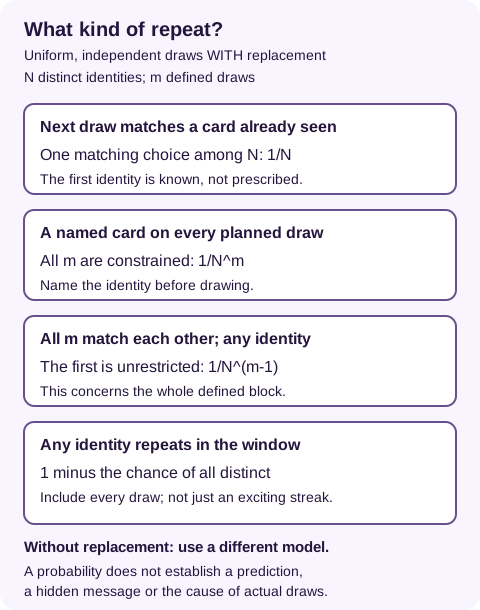
| Next draw matches an already observed card | 1 / N | The first identity is now known; one of N choices matches. |
| A named card occurs on both of two planned draws | 1 / N² | Both specified draws must be that identity. |
| All m draws match each other; any identity allowed | 1 / N^(m−1) | The first can be anything; each of the next m−1 must match it. |
| All m draws are a card named in advance | 1 / N^m | The first draw is constrained too. |
| A card named in advance appears at least once in m draws | 1 − (1 − 1/N)^m | Subtract the probability of avoiding that card on every draw. |
| Any identity repeats somewhere among m draws | 1 − product of (1 − i/N), i=0…m−1 | Subtract the chance that every draw has a new identity; for m>N, a repeat is certain within this replacement model. |
Why is the first card sometimes unrestricted? If your question is “Will these two cards match each other?”, there are N possible matching pairs among N² equally likely ordered pairs. That gives N/N² = 1/N. If you name the Tower before drawing and ask for Tower–Tower, only one ordered pair qualifies: 1/N².
NIST’s binomial distribution entry describes counts of successes in a fixed number of trials with fixed success probability. For a card named in advance in this independent model, “success” means that identity was drawn, with p=1/N. The chance of no successes is (1−1/N)^m; its complement gives at least one.
The any-repeat question has a different calculation. After i distinct identities have appeared, the next draw has N−i new choices among N choices. Multiply those no-repeat probabilities, then subtract from one. Do not use the named-card formula to calculate whether anything repeated.
Worked examples: two, three and seven draws
Suppose, for illustration, there are 78 distinct identities, every one is equally likely, and the selected identity is returned before an independent new selection. Ignore orientation. Here are six events in that exact model. Percentages are rounded; the expressions keep the underlying question visible.
| Question | Exact expression | Rounded probability |
|---|---|---|
| Next matches the first card already seen | 1/78 | 1.282051% |
| A particular named card on both planned draws | 1/6,084 | 0.016437% |
| Three planned draws all the same, any card | 1/6,084 | 0.016437% |
| Three planned draws all a particular named card | 1/474,552 | 0.000211% |
| At least one named card in seven draws | 1−(77/78)^7 | 8.636473% |
| Any repeat among seven draws | 1−(78×77×76×75×74×73×72)/78^7 | 24.197236% |
For three planned draws all matching each other, the first can be any identity. The second and third each need to match it: (1/78) × (1/78) = 1/6,084. For a particular card named beforehand on all three draws, multiply by another 1/78 because the first draw must be that named card too.
In seven draws, there are many ways for something to repeat: draws one and four could match while the rest differ, or three different pairs could occur. “Any repeat” includes all those possibilities. It is much broader than “the same card every day,” so its probability is substantially larger.
These numbers describe hypothetical repeated runs of a specified process. A 1.28% next-match chance is not a promise that the match appears once every 78 draws, or that it cannot happen twice close together. Under independence, earlier misses do not make a particular identity due on the next draw.
What if one card name has two physical copies?
Physical cards and card names need not be the same set of identities. Consider an explicitly hypothetical pool of 79 physical copies with 78 different names: name A has two copies, and 77 other names have one copy each. Select each physical copy uniformly, return it before the next selection, and assume the selections are independent. Orientation is ignored.
Name A has probability 2/79 on each selection; each single-copy name has probability 1/79. Those name probabilities are not equal. Changing the uniform-identity calculator’s N to 78 or 79 does not encode this pool. Keep its original equal-identity examples separate from this weighted-name model.
| Question defined before comparison | Exact probability | Percentage |
|---|---|---|
| Next name matches an already observed A | 2/79 | 2.531646% |
| Next name matches an already observed single-copy name | 1/79 | 1.265823% |
| Two planned names match each other; any name allowed | 81/6,241 | 1.297869% |
| Both planned selections are name A | 4/6,241 | 0.064092% |
| Counterexample: 79 distinct, equally likely names; any two-name match | 1/79 | 1.265823% |
For the any-name match, list all ordered pairs of physical copies. There are 79 × 79 = 6,241 pairs. Name A contributes 2 × 2 = 4 matching pairs. The 77 single-copy names each contribute one. The qualifying count is 4 + 77 = 81, giving 81/6,241. The counterexample row describes a different pool with 79 distinct names; it shows why a physical copy count alone is insufficient.
More generally, if name i has probability pi on each independent replacement selection, the probability of a two-name match is Σ pi². Once a previous name j is known, its next-match probability is pj. These statements follow by counting disjoint matching-name events under the stated model; they do not estimate an actual shuffle.
Without replacement: after selecting a copy of A, one A remains among 78 copies, so the next name-match chance is 1/78. After selecting a single-copy name, its name-match chance is zero. Before either selection, exactly two ordered physical pairs match by name: A-copy-1 then A-copy-2, and the reverse. Therefore the unconditional two-name match is 2/(79 × 78) = 1/3,081, about 0.032457%. Physical copy identities still cannot repeat in that block.
Use the deck checklist to record actual duplicates and extras. Do not assume this hypothetical pool describes your edition. The Major Arcana count table answers a different category-count question, not a two-name match.
The existing calculator below remains for N equally likely distinct identities. It has no weight or multiplicity field, so use this explicit table or a separately justified weighted calculation for duplicate-name pools.
Compare a model—not the cause of your actual draws
Choose N and m to compare five events under uniform, independent draws with replacement. This calculator does not draw a card, analyze your history or estimate an app’s algorithm. It uses only the two model numbers you enter. The default N=78 and m=7 are examples, not findings about your deck.
Enter whole numbers: N from 1 to 10,000 and m from 2 to 1,000. These are the calculator’s bounds, not a recommended number of tarot draws.
No calculation yet. The worked table above is available without JavaScript.
The “all m match” output concerns the entire defined block. It does not calculate the chance of finding a shorter streak somewhere inside a longer record. The next-match output concerns one additional draw after a known card; m does not change that probability in this model.
For tiny probabilities, the calculator uses scientific notation rather than rounding them to zero. Where a calculated complement is extremely close to one, it reports that closeness rather than treating numerical rounding as a guarantee. A guaranteed repeat when m>N refers only to the stated replacement model with N possible identities.
A noticed pattern is different from a prediction made beforehand
Imagine the fictional record A, B, C, A, D, E, F. It has a repeated identity because A appears twice, but no adjacent match and no three-card streak. Choosing whichever definition sounds most impressive afterward changes the event you are describing.
Before drawing, “Will the Tower appear on both of the next two draws?” names a specific event. After seeing Tower–Tower, “How unlikely was getting this exact pair?” describes one particular outcome among all possible pairs. Every exact ordered pair has probability 1/N² in the model, including two different cards; that observation alone does not show that a matching pair was extraordinary under the broader any-match question.
Keep the number of opportunities visible. If you scan a year of draws, several spreads, extra clarifiers and several definitions of “repeat,” you have looked for many possible patterns. The probability for one two-draw block is not the probability of finding any noteworthy pattern anywhere in that entire record.
There is no single percentage for “I keep seeing this card” without a defined process and event. If your record is incomplete or you changed the draw rules, report that limitation. Do not manufacture a precise number for an undefined history, or treat an unexpectedly small number as proof of a supernatural cause.
A repeat can invite a voluntary question such as “Which image detail am I noticing again?” It cannot establish “I am failing a lesson” or “This event must happen.” The reflection may be useful because you choose a concrete response; the frequency alone does not validate that interpretation.
Keep a bounded record without making it a prediction test
A record is most useful when it keeps the procedure and all outcomes visible. Choose a modest window if you already want to journal; there is no required streak or target number of repeats. Do not add draws just to obtain a statistical milestone or to find a comforting answer.
Download the editable repeated-card record. It includes the blank fields, worked probability questions, the original six practice cases, two additional duplicate-copy cases and separate explanations. It is a plain file you can edit on your own device, not a submission form or scoring system.
REPEATED-CARD RECORD — OBSERVATION BEFORE INTERPRETATION
Deck or tool used; actual selection rules known / unknown:
Distinct identities available N, if known:
Orientation recorded separately / included in identity definition:
Cards returned before each draw / one block without replacement / other:
Uniform selection and independence assumed / justified / unknown:
Event chosen before this record, if any:
Window: start, end and number of draws:
Every draw in order, including clarifiers and discarded results:
What repeated, using the original event definition:
Was the pattern selected only after viewing the results?
Procedure changes or missing entries:
My optional image association; separate from a cause claim:
Real-world facts, unknowns and one modest action or pause:
What this record cannot establish:
Log every draw in the chosen window, including cards you disliked and additional clarifiers. If you omitted results, say so. Record actual procedure changes rather than silently treating a limited-card session and a full selection as one process.
Use a separate interpretation line. “The Tower appeared on draws two and six” is an outcome statement. “I associate the picture with an unsettled project” is your association. “The project will collapse” is a prediction neither the log nor the probability model establishes.
The before-and-after guidebook exercise addresses a different question: how an identified source changes your image description and interpretation. Use it if you want to study the repeated image; it does not explain the cause of repeated selections.
If draws or calculations become distressing or interfere with ordinary decisions, take a break rather than adding another test. Use real-world information and suitable support for health, financial, legal or safety concerns. Your ability to act does not depend on receiving a different card.
Eight checks for honest questions and records
These original cases test the model, event definition and limits. They do not grade intuition or tell you how many cards to draw. Try an answer before opening its explanation.
Case 1
The first card has already been drawn. Under the N=78 uniform independent replacement model, what is the chance the next identity matches it?
Show answer and explanation for case 1
1/78, about 1.28%.
The first identity is already known. One of 78 equally likely next identities matches it. Do not require the first card to be a name specified before drawing.
Case 2
Before either draw, you name one card and ask whether both planned draws will be that card. Is 1/78 the right probability?
Show answer and explanation for case 2
No. It is 1/78² = 1/6,084 under the stated model.
Both draws must satisfy the named-card condition. This is a smaller event than two cards matching each other with any identity allowed.
Case 3
You draw three unique physical cards without returning them from a deck with one copy of each identity. Can the same physical identity occur twice in that block?
Show answer and explanation for case 3
No, not under that without-replacement procedure.
Once selected, that unique identity is unavailable for the rest of the block. Repeats across sessions after returning cards are a different event and need their own procedure.
Case 4
Your seven-draw record is A, B, C, A, D, E, F. Does it show three consecutive matching identities?
Show answer and explanation for case 4
No. It shows an identity repeated somewhere in the window.
A occurs twice on nonadjacent draws. An any-repeat event, an adjacent match and an all-matching block should not be substituted for one another.
Case 5
An app produces a repeat. Can this calculator certify that the app chooses uniformly and independently?
Show answer and explanation for case 5
No. Those are assumptions, not an audit result.
The calculator uses N and m; it does not inspect the app, test its selection mechanism or infer it from a short history. Label an unknown procedure as unknown.
Case 6
A card repeats and the probability for a chosen event looks small. Does that prove you failed to act on its lesson or that a predicted event must occur?
Show answer and explanation for case 6
No. Keep the outcome separate from an optional interpretation.
A model probability does not identify a cause or validate a prediction. You may choose a modest reflection action or pause, without claiming the draw established a missed lesson or future fact.
Case 7
In the hypothetical 79-copy pool, name A has two copies and each of 77 other names has one. With independent uniform-copy selections and replacement, is the any-name match probability 1/78?
Show answer and explanation for case 7
No. It is 81/6,241, about 1.297869%.
Name A contributes four matching ordered copy pairs and the 77 singles contribute one each, among 6,241 total pairs. Names are not equally likely.
Case 8
Without replacement from that same 79-copy pool, you first select a single-copy name. Can the next name match it?
Show answer and explanation for case 8
No. That name has no remaining copy.
After A the conditional next-name match would instead be 1/78. The unconditional match before either selection is 2/(79×78), not either conditional value.
Sources and further reading
- NIST Engineering Statistics Handbook: Binomial DistributionComplete entry: fixed-probability success counts and probability mass function. Supports the named-card complement calculation under independent trials, not tarot prediction or a shuffle audit.
- OpenStax Introductory Statistics 2e, 3.2: Independent and Mutually Exclusive EventsComplete section: independence, conditional probabilities, fair-deck replacement and without-replacement examples. Does not establish a real tarot selection mechanism.
- Tarot Tools: A 78-Card Tarot Deck ChecklistChecklist for recording duplicate names and extra physical cards; the 79-copy pool above is an original mathematical example.
Counting how many Major cards appear in a single three-card spread is a different question from matching a card’s identity. Use the complete Major Arcana count table and without-replacement examples for that category question.