Practical guide
A 78-Card Tarot Deck Checklist: Missing, Duplicate and Bonus Cards
A deck can contain 78 cards and still be missing one identity. Check all 22 Major names and four suits of fourteen, account for edition differences, and record duplicates or documented extras separately. Includes 78 checkboxes, a downloadable list and six explained cases.
Check identities as well as the total
A standard 78-card tarot set can have the right total and still be incomplete. If one card is missing and another occurs twice, counting to seventy-eight will not expose the substitution. Work through names, ranks and suits, marking the first matching physical copy and recording any further copies separately.
This checklist uses a conventional Rider–Waite–Smith reference: 22 Major Arcana cards, including the Fool, and 56 Minor Arcana cards. The Minor group has four suits of fourteen. Waite’s Four Suits chapter describes that structure; it does not certify the contents of every later deck. Your edition’s own contents take priority when it intentionally changes the set.
Put the box, booklet and cards together on a clean surface. Write the exact title, maker, language and edition if known. Separate loose leaflets from cards before counting. Avoid bending or marking the cards; you can make the inventory on paper or use the checkboxes below.
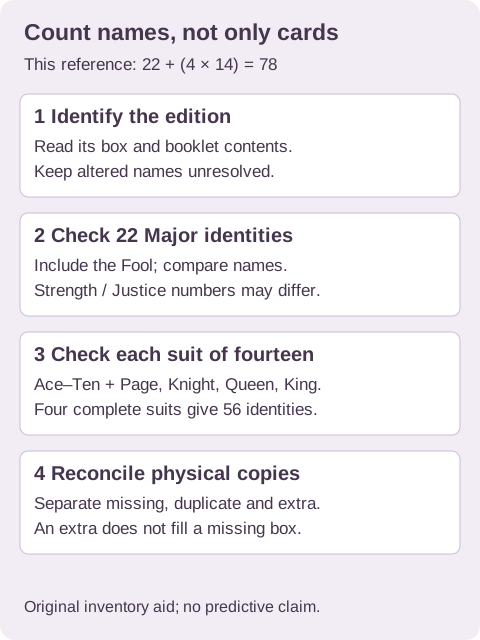
Quick route: identify the edition, check 22 Major identities, check four complete suits, then reconcile duplicates, missing cards and documented extras. For the conceptual groups, read Major vs Minor Arcana. Here the task is a physical inventory, not interpreting a draw.
The 22 Major cards: names and reference numbers
Match the actual card name and its identification, not just an image that looks familiar. The list below puts the Fool at 0, Strength at VIII and Justice at XI. It uses “Judgement” for Waite’s chapter title “The Last Judgement.” A translated or renamed card needs the edition’s own explanation before you treat it as the same identity.
Tick a box only after finding one physical copy. A second copy goes in the duplicate record instead of becoming another completed identity. The boxes are ordinary browser controls; this page does not submit or save your inventory. A refresh or browser restoration may change their state, so use the downloadable record for an inventory you want to retain.
| Reference number | Found one matching card | Identification note |
|---|---|---|
| 0 | Included in the 22; zero does not make it a bonus card. | |
| I | Match the name and your edition, then mark one physical copy. | |
| II | Match the name and your edition, then mark one physical copy. | |
| III | Match the name and your edition, then mark one physical copy. | |
| IV | Match the name and your edition, then mark one physical copy. | |
| V | Match the name and your edition, then mark one physical copy. | |
| VI | Match the name and your edition, then mark one physical copy. | |
| VII | Match the name and your edition, then mark one physical copy. | |
| VIII | Strength VIII in this reference; check your edition. | |
| IX | Match the name and your edition, then mark one physical copy. | |
| X | Match the name and your edition, then mark one physical copy. | |
| XI | Justice XI in this reference; check your edition. | |
| XII | Match the name and your edition, then mark one physical copy. | |
| XIII | Match the name and your edition, then mark one physical copy. | |
| XIV | Match the name and your edition, then mark one physical copy. | |
| XV | Match the name and your edition, then mark one physical copy. | |
| XVI | Match the name and your edition, then mark one physical copy. | |
| XVII | Match the name and your edition, then mark one physical copy. | |
| XVIII | Match the name and your edition, then mark one physical copy. | |
| XIX | Match the name and your edition, then mark one physical copy. | |
| XX | Waite’s chapter calls this The Last Judgement. | |
| XXI | Match the name and your edition, then mark one physical copy. |
Do not search for a twenty-third Major card merely because the numbering starts with zero. The Fool plus I through XXI gives twenty-two identities. A separately documented alternate Fool belongs with extras after the playing set has been checked; it cannot stand in for a missing Moon or World.
The 56 Minor cards: four suits, fourteen identities each
In each suit, find Ace through Ten, then Page, Knight, Queen and King. The Ace is the first numbered identity in this count; it is not a bonus card. Court cards belong to the Minor group here, even when their artwork looks more prominent or they have individual names.
Read across a row to compare the same rank in four suits, or down a column to finish one suit. Each label names its suit as well as rank. Finding the Two of Cups does not allow you to tick the Two of Swords, and a reversed card is the same physical identity turned around.
| Rank | Wands | Cups | Swords | Pentacles |
|---|---|---|---|---|
| Ace | ||||
| Two | ||||
| Three | ||||
| Four | ||||
| Five | ||||
| Six | ||||
| Seven | ||||
| Eight | ||||
| Nine | ||||
| Ten | ||||
| Page | ||||
| Knight | ||||
| Queen | ||||
| King |
The arithmetic is ten numbered cards plus four courts in each suit: 14 × 4 = 56. Add the 22 Major identities to obtain 78. Keep that calculation separate from the number of loose pieces in the box, which may include a booklet, information cards or edition-specific additions.
For study after the inventory, the Minor Arcana guide and card index offers a separate suit-card task. You do not need to interpret the pictures to establish whether all four Kings are physically present.
Resolve edition differences before declaring a card missing
Check name, number and edition together. In Waite’s account, Strength is VIII and Justice XI. He explicitly says Strength was interchanged with Justice, usually numbered eight. The historical image comparison shows the selected Dodal Justice VIII and Force XI examples. Those two arrangements explain why “I have card eight” is an incomplete identification.
Use the actual label in your notes: “Justice VIII, edition named on my box,” rather than silently changing it to Strength. A difference in numbering does not establish that the set is incomplete, counterfeit or more accurate for readings. The edition’s full list is still needed to check the remaining cards.
Waite’s structural description uses Wands or Sceptres and Pentacles, also called Deniers or Money. That vocabulary can help you investigate a label; it is not permission to map every modern renamed suit automatically. If a booklet identifies its own correspondence, note that exact mapping and where you found it.
Apply the same care to courts. Do not automatically equate Princess with Page, Prince with Knight, or another title with King. Some redesigned decks change both naming and structure. Copy the printed court titles into an unresolved list until you have the edition’s documented arrangement. A custom or nonstandard set may need a different checklist altogether.
Record missing, duplicate, extra and unresolved pieces separately
Missing: a required identity has not been found after checking the full set, packaging and sorting piles. Write its complete name. “A cup card” is too vague; “King of Cups, absent from the reference playing set” describes an issue another person can inspect.
Duplicate: a further physical copy matches an identity already counted. Compare front labels, artwork variants and booklet contents before calling it an accidental duplicate. Shared card backs are normal for many decks and cannot identify which front is duplicated. Two cards need not have matching backs to be edition-documented alternates.
Documented extra: the edition explicitly lists a bonus, alternate, blank or information card outside its playing set. Record its wording and the contents reference. Do not assign a purpose to an unknown blank card just because another deck uses blanks. An extra never fixes a missing required identity unless the edition actually specifies a replacement.
Unresolved: the identity, purpose or edition is not yet established. Keep the card separate and write what you can observe. “Unlabelled card with this picture; not explained in the booklet I have” is more useful than guessing that it proves a misprint.
For a worked count, suppose a set has 21 distinct Majors, all 56 Minors and a second copy of one Major. It totals 78 physical cards but only 77 required identities. Suppose instead that all 78 identities are present and a hypothetical booklet documents two alternate designs: the inventory is complete with two extras, totaling 80 physical cards. These are arithmetic examples, not advertised contents of a named product.
Finish by reconciling two records: the required identities present, and all physical cards counted. If those disagree, recount the affected piles rather than starting a new interpretation. If asking a publisher or seller about a possible packing problem, include the edition, specific missing or duplicate names and clear photographs as requested by their normal support process. This checklist does not establish a warranty entitlement or authenticate a collectible.
Use the inventory route and keep a durable record
View the four-step inventory route. The order matters because the box total is meaningful only after you know what the edition intends to contain. Start with identity, finish with reconciliation, and leave a genuine unknown visible.
Download the full 78-card checklist and edition record. It contains one checkbox line for every identity, separate spaces for missing and duplicate cards, documented extras and unresolved labels, plus the six practice cases and answer notes. Copy it into a plain-text editor or use it as a paper checklist.
DECK TITLE / MAKER / EDITION / LANGUAGE:
EDITION CONTENTS REFERENCE:
MAJOR IDENTITIES PRESENT: __ / 22
MINOR IDENTITIES PRESENT: __ / 56
MISSING REQUIRED NAMES:
DUPLICATE PHYSICAL COPIES:
DOCUMENTED EXTRAS AND SOURCE:
UNRESOLVED LABELS OR PIECES:
ALL PHYSICAL CARDS COUNTED:
NEXT SPECIFIC CHECK:
A useful finished record might say: “All 22 Majors present; Cups missing its King and has a second Queen; other suits complete; no extras documented in this booklet.” That explains the discrepancy instead of simply saying the deck has 78 cards. Date the record if you plan to recheck after obtaining a replacement or edition information.
Six inventory checks with explained answers
Try each case before opening the notes. These original examples test card identity, count and source matching. They do not test intuition or make a prediction about the person handling the deck.
Case 1
You count 78 cards. The Queen of Cups appears twice and the King of Cups is absent. Is the standard playing set complete?
Show answer and explanation for case 1
No. There are 78 physical cards but only 77 different required identities.
Set one Queen aside as a duplicate, leave the King unchecked and record both names. The total alone hid the problem. If this is the edition’s standard set rather than a documented alternate-card arrangement, those two photographs and the edition details give the publisher or seller a specific issue to investigate.
Case 2
Your set contains the Fool numbered 0, plus cards I through XXI and all four complete suits. Is zero an extra twenty-third Major card?
Show answer and explanation for case 2
No. The Fool is one of the 22 Major cards in this reference.
Zero plus the twenty-one numbered trumps gives twenty-two identities. You do not need to find a card XXII to complete this list. Check a different deck against its own contents instead of extending the sequence just because it starts at zero.
Case 3
Your identified Marseille-style edition has Justice VIII and Force XI. This table has Strength VIII and Justice XI. Are two cards necessarily missing?
Show answer and explanation for case 3
No. A different documented numbering arrangement can account for the mismatch.
Record the names and numbers from the actual edition. The linked image comparison shows the selected historical Dodal arrangement, while Waite explicitly describes interchanging Strength with Justice. Do not rename Justice as Strength just to match a number; a whole deck still needs its own identity check.
Case 4
A hypothetical edition’s booklet lists the usual 78-card set plus two alternate Fool designs. All 78 required identities are present and the two alternates are separate. What total should the inventory record show?
Show answer and explanation for case 4
78 required playing identities present, plus 2 documented alternate cards: 80 physical cards.
This is an invented arithmetic example, not the contents of a named commercial product. Record the edition’s stated extras separately. Two alternate Fools should not fill a missing suit-card box, and their presence does not by itself prove that another manufacturer’s deck should also contain them.
Case 5
You have Ace through Ten and Page, Knight and Queen in each suit, but no Kings. The four suits contain 52 cards. What is missing in this reference?
Show answer and explanation for case 5
The four Kings: one in Wands, Cups, Swords and Pentacles.
Each suit needs ten numbered cards and four courts, for fourteen. Thirteen per suit gives fifty-two, not the fifty-six-card Minor group. Kings are Minor court cards here; moving them into the Major pile would conceal the error rather than complete the set.
Case 6
A custom deck uses unfamiliar suit names and three different court titles. Can you automatically tick Page, Knight, Queen and King boxes from similar-looking pictures?
Show answer and explanation for case 6
No. Keep the identities unresolved until the edition’s own mapping is established.
A redesign may deliberately change the structure or names. Record the printed labels, the maker or edition and what its booklet actually says. Do not invent a one-to-one correspondence or declare a manufacturing defect merely because this conventional checklist does not fit.
After counting, choose the next task deliberately
If the inventory is complete, put the cards back into a sequence you can check again. If a question remains, keep the unresolved list with the edition information. There is no need to force a result, buy another deck or draw cards to explain why a physical piece is absent.
Card inventory, image comparison, spread position and personal association are different tasks. The two-card spread exercise labels position before interpretation. The guidebook comparison exercise separates an initial observation from an attributed source. Use those when you want a reflection or creative exercise after the physical set has been checked.
A missing, duplicated or unfamiliar card is a question about the objects and their edition. It does not reveal an absent person’s feelings, cause an event or provide medical, financial or legal advice. Keep actual evidence and any symbolic use in their own records.
Sources and further reading
- A. E. Waite: Section 3, Class II — The Four SuitsHistorical description of 22 trumps and four suits with ten numbered cards and four courts each. The displayed contents identify the reference card names. This supports the structure used here, not the contents of every modern commercial deck.
- A. E. Waite: VIII. Strength, or FortitudeStrength VIII chapter and Waite’s explicit statement that he interchanged Strength with Justice, usually numbered eight. His theological and divinatory interpretations are not adopted as factual predictions.
- A. E. Waite: XI. JusticeJustice XI chapter identification in the same reference. A historical numbering arrangement, not authentication of a physical deck or a rule for every edition.
Make the recorded card information usable
Use a labelled original diagram and completed study record to distinguish visible information, source wording and your interpretation without relying only on color.