Practical guide
Tarot de Marseille vs Rider-Waite-Smith: Image Traditions Compared
Compare the actual cards before transferring a scene or keyword. Study credited historical Two of Cups images, check the different Justice and Strength numbers, and keep visible details, historical source claims and your own interpretations separate.
The useful difference is in the picture you actually have
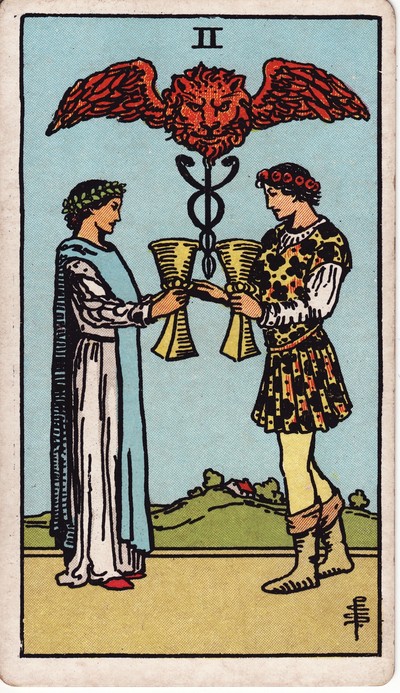
Tarot de Marseille and Rider–Waite–Smith should not be treated as interchangeable picture dictionaries. A useful starting contrast is between the emblem-and-ornament arrangement in the pictured Dodal Two of Cups and the human scene in Smith’s Two of Cups. Both have two cups, but they offer different material for a visual description. Their shared card name does not make the scene details transferable.
“Marseille” here names the image tradition represented by these particular Jean Dodal examples. It is not a claim that every deck with that label is identical or that every card was produced in the city of Marseille. The file records identify Dodal with Lyon. “Rider–Waite–Smith” names the tradition discussed through Smith’s pictured card and A. E. Waite’s commentary. Including Smith in the name makes the pictured artist visible; it does not settle every detail of publishing history.
Use this guide to compare images, choose a suitable source and decide what to study next. It does not provide a fortune-telling result or a full catalogue of historical tarot. For the basic distinction between trumps and suit cards, use the Major and Minor Arcana guide; the present task is how particular images and numbering arrangements differ.
| Feature | Dodal example | Smith / Waite example |
|---|---|---|
| Names and suits | This comparison uses named historical Dodal files, including Cups, Justice and Force. | This comparison uses Smith’s Two of Cups and Waite’s named commentary; labels and numbers must be checked in the actual deck. |
| Numbered suit-card image | The pictured Two of Cups uses two vessels and an elaborate ornamental arrangement without a human pair. | The pictured Two of Cups includes two cup-bearing people and a particular interaction scene. |
| What to observe | Count the emblems; follow their placement, curves, spaces and printed words. Ornament is still an image to examine. | Describe the figures, objects and spatial relationships before deciding what the scene might suggest. |
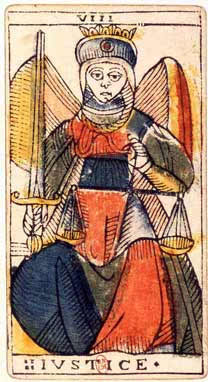
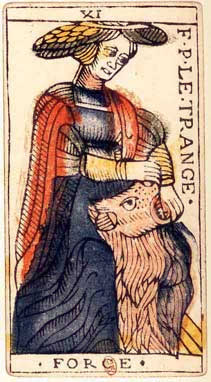
| Trump numbering | The displayed Dodal Justice is VIII and Force is XI. | Waite’s Strength chapter is VIII; his Justice chapter is XI. Do not identify a trump by number alone. |
| Guidebook use | A scene description for Smith’s card cannot supply figures missing from the Dodal card. Use a source that identifies its own tradition. | Waite’s account is a historical interpretation of these images, not a universal answer for every redesign. |
| Limits of the comparison | Three Dodal images do not catalogue every Marseille deck or establish all their meanings. | One Smith suit image and two chapters do not prove that every modern illustrated deck follows this design. |
Look closely: two historical Two of Cups examples
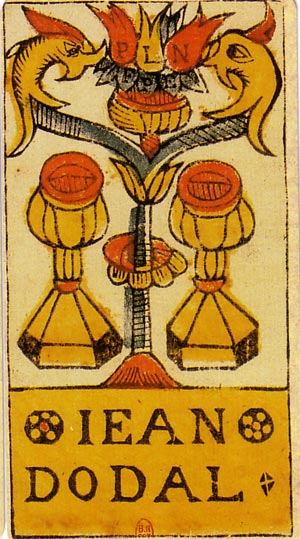


Begin with the vessels rather than with a memorized keyword. In the Dodal image, two cups sit on either side of a central stem. Above them, paired curved animal-like forms and other ornament produce a roughly balanced arrangement. The large maker-name panel is part of this reproduction. It is a mistake to call the picture empty simply because it lacks the human scene in Smith’s card.
In Smith’s image, two standing figures face each other while holding cups. A staff with intertwined serpents rises between them; a winged lion head appears above. There is also a landscape behind the figures. These are concrete things to examine before proposing a story. “The gesture reminds me of an exchange” is an association you can state; it is different from claiming that the card has detected a real exchange in your life.
| Look for | Dodal Two of Cups | Smith Two of Cups |
|---|---|---|
| Cup count | Two prominent cups, below the upper ornamental forms. | Two cups held by the facing figures. |
| Human figures | No human pair is present in this particular card. | Two standing people face one another. |
| Upper part | Curving animal-like forms surround a central ornamental feature. | A winged lion head sits above intertwined serpents on a staff. |
| Printed information | The maker’s name Jean Dodal occupies the lower panel; count the cups rather than assume a matching II label. | II appears above the scene; a small artist mark is visible near the lower right. |
| A cautious study question | How do paired cups and the central axis organize the image? | How do the figures’ facing positions and cup gesture organize the scene? |
| An unsupported leap | “Two cups guarantee a new relationship.” The emblems do not establish that event. | “Those people prove my friend’s private feelings.” A depicted scene does not establish a real person’s thoughts. |
Waite’s Two of Cups commentary describes a youth and maiden pledging one another and calls the central emblem the Caduceus of Hermes, with a lion’s head between wings. Attribute that description to Waite rather than presenting it as your independent discovery of an artist’s intention. His chapter then supplies divinatory associations. Those associations document an interpretive tradition; they do not verify an event or someone’s feelings.
Use two different starting methods for the same modest task
Choose a small task such as making a thumbnail sketch about “two things in relation.” Keep it fixed while comparing the cards. You do not need a personal question, a random draw or an account. This is an original image-study exercise, not a tested lesson with a promised improvement.
For the pictured Dodal card: record the two emblems, central axis, upward and outward curves, spaces and printed maker name. Choose one feature to sketch. For example: “I will compare how the two cups frame the central stem.” If you introduce a number association, label its source or call it your chosen convention. Counting two cups is an observation; defining two as universal harmony is an interpretive rule.
For Smith’s pictured card: record the people, cup positions, facing directions and central emblem. Then choose a detail to sketch: “I will study the facing poses and the gesture between the cups.” You can ask whether the scene suggests reciprocity to you, but the answer remains your response to this artwork. It is not information about an absent person.
Compare the sketches by the task you chose. The Dodal card might offer a useful ornamental study; Smith’s might offer a useful gesture study. Neither has to lose for the comparison to be worthwhile. If one image leaves you uncertain, write the uncertainty instead of drawing more cards to force a confident answer.
A guidebook may begin with numbers, suit associations, image symbolism or another approach. Check what it actually says and which deck it describes. Do not present one brief exercise as the complete Marseille reading method, and do not assume that a scene makes an interpretation automatic. The before-and-after source exercise addresses a separate question: what changes after you consult a named commentary.
Check Justice and Strength by name as well as number


| Card identification | Displayed Dodal example | Waite chapter |
|---|---|---|
| Justice | VIII, with the Justice name, sword and scales | XI. Justice |
| Strength / Force | XI, with Force and a person handling a lion | VIII. Strength, or Fortitude |
Roman numerals alone are insufficient when switching these examples. The displayed Dodal Justice bears VIII; Force bears XI. Waite’s chapters reverse that arrangement: Strength is VIII and Justice XI. In his Strength commentary, he explicitly says he interchanged the card with Justice, which is usually numbered eight. His Justice chapter supplies the XI identification.
Record a card as “Dodal Justice VIII” or “Waite Strength VIII,” rather than writing only “eight.” This prevents a memorized list from silently changing the picture you are discussing. It also gives a future reader enough information to understand your notes.
The two displayed arrangements do not establish a universal numbering rule for every modern deck. A redesign can use another sequence or labels. Check its printed names, images and own documentation. Do not infer that a different number makes a card counterfeit, more authentic or more powerful.
Keep dates, reproductions and historical claims within their evidence
The Dodal Commons descriptions date the pictured deck examples between 1701 and 1715 and name Jean Dodal. The Smith Two of Cups record identifies a Pam-A card, lists 1910 and credits Pamela Colman Smith. These are the dates and identifications supplied for the selected image records. They are not a claim that these files establish the first appearance of all tarot or the first release of every version of either deck.
A historical card and its digital reproduction have different histories. The original artwork can be old while the file was uploaded or adjusted much later. The two Dodal trump histories record a 2024 colour adjustment. Smith’s current image is a higher-quality scan uploaded in 2024. The lower-resolution Dodal cup reproduction and the resized Smith image are suitable for the present composition study; they do not allow measurement of original inks or authentication of a physical card.
Each displayed image links to its record and public-domain notice. The Dodal records credit Tarot History as the source; the Smith record credits a scan source at muzendo.jp. This page retains those provenance links and artist or card-maker credits. Public-domain notices describe copyright status; they are not evidence that an esoteric explanation, a catalogue date or every uploader’s comment is historically certain.
Waite’s Four Suits chapter describes ten numbered cards and four court cards in each suit, alongside twenty-two trumps. It also makes broad claims about pictorial cards and symbolic history. Use the chapter as Waite’s historical account, not as an exhaustive current survey or proof that Smith invented every scene on a suit card. We do not need an absolute “first ever” claim to compare the pictures in front of us.
A repeatable observation workflow, with an original diagram
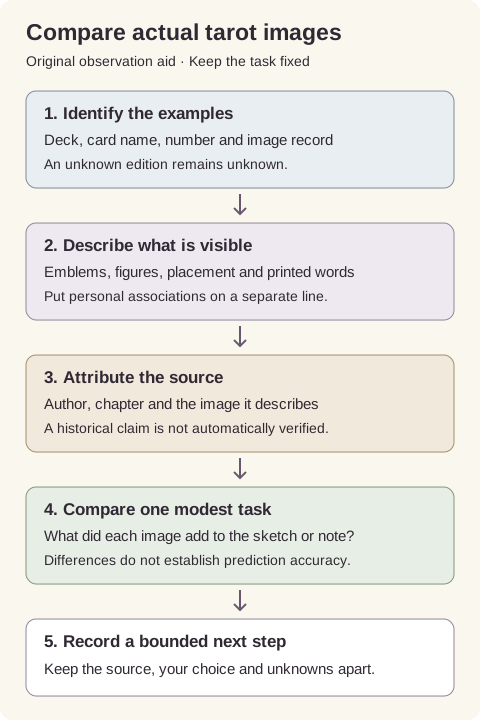
Identify first. Write both deck examples, the card names, visible numbers and the exact image record or edition. If you do not know an edition, mark it unknown. Keep the orientation fixed so that a rotation does not become an unnoticed extra change.
Describe before interpreting. Write two or three features you can point to in each picture. Then place personal associations in a separate line. You can use a sentence such as “I associate this balanced arrangement with a pair,” but keep “I associate” visible.
Attribute the source. Name the author and relevant chapter when recording an interpretation. Ask whether it describes the same image. If it refers to a missing figure, note the mismatch. If it makes a historical assertion, do not upgrade that assertion into a verified chronology without a suitable historical source.
Compare one task. Use the same sketch, description or reflection prompt for both images. Say what each image contributed and what remains unresolved. Finish with a specific action such as sketching the central axis, reviewing a caption or looking up your deck’s edition. The point is a clear comparison you can inspect later, not accumulating meanings until everything sounds certain.
Six checks before transferring a meaning or historical claim
Try the questions before opening the explanations. These original cases concern observations, source attribution and what a comparison can establish. They do not test intuition, grade a spiritual practice or measure prediction.
Case 1
A book says the Two of Cups shows two people exchanging pledges. Your Dodal image has two cups and ornament, without those people. Should you describe an invisible couple?
Show answer and explanation for case 1
No. Describe the actual image, and label the book’s scene as belonging to a different artwork. You may compare interpretations afterward, but should not insert missing figures into an observation.
A common card name allows comparison; it does not make every deck’s picture identical. A source mismatch is useful information to record.
Case 2
You write “the cups are arranged as a pair” and then “the pair makes me think of mutual attention.” Which sentence is a visible observation?
Show answer and explanation for case 2
The first sentence reports a feature you can point to. The second is your association and should keep that attribution.
An association can be useful for a sketch or reflection without becoming either an artist’s documented intention or a fact about the future.
Case 3
A list says card VIII is Strength. Your displayed Dodal card VIII says Justice and shows scales and a sword. Which identification should you use?
Show answer and explanation for case 3
Identify the actual card as Dodal Justice VIII and record the deck. Waite’s Strength VIII belongs to the other numbering arrangement.
Compare names, numbers and images together. Do not relabel a pictured Justice card to make it match a memorized list.
Case 4
A source calls its smaller suit cards newly pictorial. Does that sentence prove that no earlier tarot anywhere had scenes on suit cards?
Show answer and explanation for case 4
No. A historical author’s broad claim is not an exhaustive modern historical survey. This article compares the pictured examples and does not claim an absolute first illustrated deck.
Waite’s Four Suits chapter supplies his account and useful structural information. Its promotional and historical assertions require separate evaluation.
Case 5
Two downloaded scans have different colours and different amounts of visible ageing. Can this comparison establish the exact original colours of every printing?
Show answer and explanation for case 5
No. Record which reproductions you used and check the file histories. Different scans, adjustments, copies and editions can affect appearance.
The Dodal trump file histories explicitly record a colour adjustment. These digital examples support a visible comparison, not a colour measurement or authentication of a physical card.
Case 6
After comparing the images, you prefer an illustrated scene for a drawing prompt. Have you shown that one deck predicts events more accurately?
Show answer and explanation for case 6
No. You have stated a preference for a particular visual task. Keep the reason—such as studying gesture—without turning it into an accuracy or superiority claim.
The exercise produces observations and a practical choice. It has no prediction test, participant study, spiritual score or measured effect on learning.
Choose by your learning task, then keep a useful record
If you enjoy a figure scene, choose a source and deck that let you study that scene. If you want to explore emblem count, pattern and ornament, the pictured Dodal card supplies different material. State the reason for the choice: “I want to study gesture,” “I want to sketch symmetry,” or “I want to compare sources.” This is more informative than saying that one tradition is universally easier, deeper or more accurate.
You can begin with the images already on this page. Buying another deck is not necessary for the exercise. If you later compare a physical deck or modern reproduction, use its actual card and publication details; do not assume that a familiar box label makes every image match these historical examples.
Download the editable comparison record. It includes a blank twelve-field record, an original worked Two of Cups comparison, the six practice questions and separate answer notes. It opens as ordinary text and can also be copied into a paper notebook. The worksheet is a download, not an online account or a saved server journal.
Keep the actual image observation, the author’s account and your own proposed next step in distinct fields. A short note with an honest unknown is enough. For a broader fiction task, use the character and conflict prompts. For spread structure, use the two-card position exercise. Those tasks can use images creatively while keeping the particular deck and the limits of interpretation clear.
Sources and further reading
- Commons: Jean Dodal Two of CupsSelected image identity, 1701–1715 date range, card-maker and provider credit, and public-domain notice.
- Commons: Pamela Colman Smith Two of CupsSelected Pam-A scan identity, listed 1910 date, artist credit, current scan history and public-domain notice.
- Commons: Dodal Justice VIIIImage, visible VIII and Justice identification; digital file history records a colour adjustment.
- Commons: Dodal Force XIImage, visible XI and Force identification; digital file history records a colour adjustment.
- A. E. Waite: Two of CupsComplete attributed description of the pledging figures, caduceus and lion head; divinatory associations are historical claims.
- A. E. Waite: VIII. Strength, or FortitudeComplete historical explanation that Strength VIII was interchanged with Justice; theological claims are not treated as established facts.
- A. E. Waite: XI. JusticeComplete Justice XI commentary; source perspective, not a result about an actual legal or moral question.
- A. E. Waite: The Four SuitsComplete structural description of four suits, ten numbered cards and four courts; broad historical assertions are not adopted as an exhaustive survey.