Practical guide
Tarot for Creative Writing: Character, Conflict and Setting Prompts
Use tarot cards as a set of image prompts for fiction: one can suggest a character, another an obstacle, and a third a place that changes what the character can do. Observe a detail, invent a story possibility, then connect the choices through action and consequence. The cards do not predict a plot or establish facts about a real person.
Give three cards three writing jobs
For this original exercise, label three positions before choosing cards: character, conflict and setting. You may select cards deliberately or use a shuffled deck if you enjoy the surprise. Neither method makes the resulting story more factual.
The positions describe parts of one scene. They do not mean past, present and future, and reading from left to right does not require the story events to occur in that order. If you want another layout, state its jobs rather than guessing what the position must mean.
You need a deck or readable card descriptions, paper and a willingness to invent. You do not need to memorize all 78 meanings. Start with one visible detail from each card, then write what you choose to make it mean in this particular fictional situation.
A useful starting question is “What scene could these images help me invent?” It keeps the task with the writer. “What will happen to me?” asks a different question and is not the purpose of this exercise.
Move from observation to invention to action
| Image detail | One invented possibility | Action it could produce |
|---|---|---|
| A figure looks at a fish emerging from a cup. | A courier receives an unexpected object with the message. | The courier tries to conceal it while reaching the destination. |
| Several figures brandish staves. | Rival crews each want control of a shared crossing. | They block one another and prevent the courier passing. |
| A path runs between towers under moonlight. | The courier can see a possible route but not where it ends. | They must choose between waiting and trying the uncertain route. |
The first column draws on the historical descriptions linked below. The second and third columns are original inventions. The cards do not contain a courier, a delivery deadline or the crews’ specific motives; the writer adds those.
That distinction gives you room to change the idea. A cup could prompt a laboratory sample, a prized trophy or an awkward gift. Competing figures could become a rehearsal dispute or a disagreement over equipment. Choose the version that produces a clear action in the story you want to write.
A symbol is not yet a scene. “Curiosity,” “competition” and “uncertainty” are broad themes. Give each theme an object, person, constraint or decision the reader can observe.
Use historical descriptions without turning them into rules
The example uses imagery associated with the Rider–Waite–Smith tradition as described in A. E. Waite’s The Pictorial Key to the Tarot. In the Page of Cups entry, a figure contemplates a fish rising from a cup. Waite connects the image with pictures of the mind taking form and supplies historical divinatory associations.
The Five of Wands entry describes youths brandishing staves as if in sport or strife, calling the scene mimic warfare. This supports noticing group activity or competing movement. It does not require writing a fatal battle, five villains or a financial prediction.
The Moon entry describes the path between towers, a dog and wolf, and reflected light leading toward the unknown. Waite’s explanation is a spiritual commentary. Here the path and limited visibility become practical prompts for a fictional place and choice.
This exercise does not adopt the text’s divinatory claims or demographic assignments. A court-card figure does not require a protagonist of a particular gender or age. If your deck depicts these cards differently, observe its actual image rather than attributing Waite’s details to artwork that does not contain them.
The diagram below uses named cards and original writing roles. It is not a reproduction of historical card faces, a claim about the earliest tarot, or a universal spread convention.
A three-card map for the worked scene
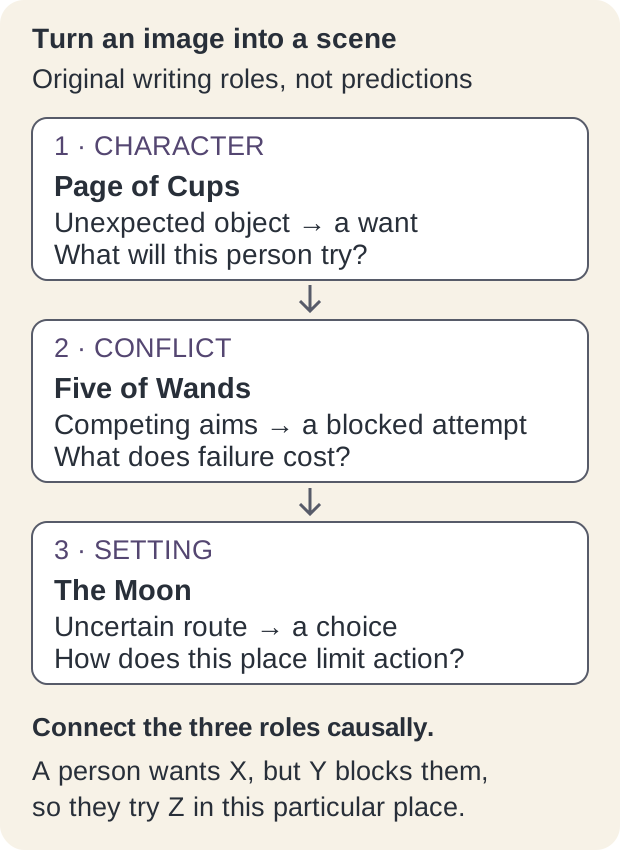
Download the original story-prompt map. Use it with the worked example or substitute three other named cards.
Keep one role per card for the first attempt. If you use every image for every role, the exercise can become an unstructured collection of associations. You can complicate the method after you have a working scene.
Worked example: turn the three prompts into a scene
1. Choose a goal and an obstacle
Invent an apprentice courier named Tali. She wants to deliver a sealed message before the harbor’s second lantern bell. An unexpected fish in the cup she carries makes hiding the delivery awkward. Rival festival crews obstruct the only crossing because each wants its lantern carried first.
The goal, deadline, profession and motives are invented. The Page supplies an unexpected-object prompt; the Five supplies competing activity. Give the obstruction a reason connected to the courier’s task instead of adding a random argument beside it.
2. Make the setting change the available action
Use the Moon’s uncertain path as a narrow canal route between watchtowers. Moonlight catches the water but does not reveal where the route ends. Tali can wait for the crews to finish arguing or try the canal path and risk missing the destination.
The place now affects the choice. It is doing more than adding a moon-shaped decoration to an otherwise unchanged scene.
3. Write a causal premise
“An apprentice courier wants to deliver a sealed message before the second lantern bell, but rival crews block the crossing, so she must risk an uncertain canal route.” This sentence does not explain the tarot meanings. It tells us who wants what, what prevents it and what action follows.
4. Draft the moment
The fish in Tali’s borrowed cup opened its mouth as the first lantern bell sounded. She pressed her sleeve over the rim and stepped toward the crossing. Five festival crews had wedged their poles across it, each insisting that its lantern deserved the front of the procession.
“One person,” Tali said, holding up the sealed message. “I only need room for one person.”
The nearest carrier lowered another pole. “Then persuade the other four.”
Between the watchtowers, a thin line of moonlight marked the canal wall. It looked wide enough for a foot, though Tali could not see where it ended. A dog barked from the far bank. The second bell would close the harbor office.
She tucked the message inside her coat, uncovered the cup and whispered, “If you know the way, now would be a useful time to say so.” Then she stepped onto the wall.
This is an original fantasy opening, not a quotation or a claim that the cards revealed an event. Its ending gives Tali a decision and changes her situation. A later draft still needs to establish what happens and whether the invented world’s rules remain consistent.
Keep the cards and change the genre
The same prompts can produce backstage comedy. Mara, an inexperienced props assistant, must get a borrowed cup onto the stage before a cue. Five performers each insist their rehearsal needs the only available platform. A dim route between two tall set pieces offers an inconvenient way around them.
The cup now contains a rubber fish that squeaks when squeezed. The uncertain route is a cluttered backstage passage, not a supernatural canal. Mara’s goal is to make the cue; the obstruction is a scheduling dispute; the cost of failure is a missed entrance and a visible mistake.
Mara tried to edge through the rehearsal group with the cup hidden against her apron. Its rubber fish squeaked. All five performers stopped arguing about the platform and looked at her.
“That,” said the director from the dark auditorium, “is the sound we needed.”
Mara could explain the accident and delay the cue, or squeeze the fish again and pretend it had been rehearsed. She squeezed.
This variation keeps unexpected object, competing people and limited visibility while changing the invented situation and tone. It does not need every card detail. The two drafts are alternatives the writer creates, not competing predictions whose accuracy must be judged.
If a literal fish, exactly five people or two towers feels forced in your story, keep the function and change the object or number. The exercise serves the scene; the scene does not need to prove that every symbol was included.
Twelve prompts to make the roles concrete
| Character | Conflict | Setting |
|---|---|---|
| What does this person want before the scene ends? | Who or what blocks that specific goal? | What route or space limits the first attempt? |
| Which object do they carry, protect or hide? | What does the opposing person or force want? | What can the character see, hear or touch? |
| What do they know that another person does not? | Why does the first reasonable attempt fail? | Which resource is scarce here: light, room, time or access? |
| What choice would expose a weakness or commitment? | What changes if they cannot complete the task? | What change in the place forces a new choice? |
Answer only the questions that help your draft. You do not have to fill a character biography before writing a scene. A single desire, obstacle and consequential choice can be enough for a first attempt.
For revision, ask a reader what the protagonist wants and what prevents it. If the answer is unclear, clarify the action or consequence. Drawing more cards does not automatically solve a missing causal connection.
A short practice loop you can repeat
- Choose the roles and cards. Write character, conflict and setting. Select one card for each.
- Record observations. Note one visible detail or a clearly identified detail from a source description.
- Invent possibilities. Add a want, obstacle and place constraint. Mark them as your story decisions.
- Connect the actions. Write a premise using wants, but and so, or another structure that makes the consequence clear.
- Draft and revise. Try a short scene, then read it without the card names. Strengthen the action that still feels vague.
A draft of roughly 150–300 words can be a manageable experiment, but that range is a suggested size rather than a rule about creativity. Use whatever length serves your task. You can reuse the cards for another genre, or stop after one workable paragraph.
Keep the record if it helps you see your choices. A fiction exercise does not require revealing your own distress, interpreting a real person’s motives or turning a personal experience into a story. Ordinary invented circumstances are enough.
Download an editable scene worksheet
Download the twenty-field scene worksheet. It separates visible details from inventions and leaves space for a premise, attempted action, consequence and revision. The worksheet and prompt map are original resources.
Observed image detail: _____________________________
Story possibility I invent: ________________________
Character wants: __________________________________
But the obstacle is: _______________________________
So the character tries: ____________________________
The place changes the choice by: ___________________
Keep this as a writing record rather than a test of divination. The draft succeeds when its actions and choices make sense to a reader. You can remove the card names entirely from the finished story.
Five draft checks with possible answers
These original exercises focus on making a scene usable. The suggested answers illustrate revision choices; they do not assign one compulsory meaning to a card.
Case 1
You draw the Page of Cups and write, “A young man must be the protagonist because the guidebook says so.” What needs changing?
Show answer and explanation for case 1
Treat the depicted figure as a prompt, not a casting rule.
Choose the character’s identity, age and role for your story. The historical description is not an obligation to reproduce its demographic assumptions.
Case 2
Your conflict note says only, “Five of Wands means conflict.” What detail would make it usable in a scene?
Show answer and explanation for case 2
Give the obstacle an action, aim and consequence.
For example, rival crews each want control of the only crossing, so the courier cannot deliver the message. A label alone does not explain what blocks the goal.
Case 3
The Moon gives you “a mysterious place,” but the protagonist could act exactly the same way anywhere. What should the setting prompt add?
Show answer and explanation for case 3
A concrete constraint on action.
Poor visibility, a narrow route or an unreliable landmark can change the choice available. Atmosphere helps, but a functional setting affects the scene.
Case 4
You keep all three cards but change a canal fantasy into backstage comedy. Have you invalidated the exercise?
Show answer and explanation for case 4
No. The story decisions are yours.
The same image details can suggest different invented situations. Keep the roles clear and make each version work causally; there is no single predicted plot to preserve.
Case 5
Your draft explains every card meaning and never shows the character trying anything. What is the next revision?
Show answer and explanation for case 5
Replace abstract interpretation with an attempted action and a response.
Show what the character does, how resistance appears and what choice follows. The reader should be able to understand the scene without a tarot explanation.
Sources and further reading
- A. E. Waite: Page of Cups, The Pictorial Key to the TarotHistorical figure and fish-in-cup description. Character identity, courier role and unexpected-object story prompt are original adaptations.
- A. E. Waite: Five of Wands, The Pictorial Key to the TarotFigures brandishing staves, sport/strife and mimic-warfare description. Rival crews and blocked crossing are invented fiction.
- A. E. Waite: XVIII. The Moon, The Pictorial Key to the TarotPath between towers, dog/wolf and reflected-light commentary. Canal and backstage setting constraints are modern writing choices.