Creative Block Tarot Spread: One Small Restart
Revised · Tarot card study and optional reflection
Use a creative block tarot spread to propose one small experiment with the work already in front of you. Name the stuck point, consider one constraint and choose a draft, cut, lookup or feedback task. The test produces an artifact or information; the cards do not diagnose the block or judge your talent.
Put the actual unfinished work beside the spread
Name the project and its present state before selecting cards. “I have six opening paragraphs and keep changing the first sentence” is useful context. “I have no creative energy” is broader and may hide several different problems. The exercise works with a draft, sketch, short musical phrase, reference list or another visible piece of work.
Choose a question you can test: “What small change could help me finish one opening draft?” Decide what a manageable result would be, such as one saved version or one answer from a project brief. This is an original creative-process exercise; no evidence is offered that tarot treats procrastination, burnout or a health condition.
For the separate task of inventing characters and scenes, use tarot for creative writing. Here you are working on a named obstacle in an existing project, not asking cards to invent a complete plot.
Give three cards three process jobs
On a narrow screen, scroll this table sideways to read all columns.
| Position | Question for the work | What the card cannot establish |
|---|---|---|
| Context | Where is this task currently stuck, based on what I can see? | A diagnosis of the creator or the real cause of the block. |
| Tension | Which constraint could I consider changing for one attempt? | A hidden fear, a guaranteed solution or somebody else’s judgment. |
| Action | What small draft, cut, lookup or feedback test could I try? | An instruction to ignore actual limits or a promise of success. |
Keep these labels fixed. You may choose practice cards deliberately or use a deck if you enjoy the surprise. The three-card tool offers a Context / Tension / Action preset; record its labels and treat any generated interpretation as a prompt you can reject. You do not need a fresh draw if you already have a workable test.
Worked example: stop polishing the opening
Imagine the project is a short workshop introduction. You have six draft openings but no complete version. Select Eight of Pentacles for Context, Two of Pentacles for Tension and the Magician for Action as illustrative cards. The associations are your choices for this example, not observed results or facts discovered by the cards.
For Context, careful craft reminds you that revision is useful, but the visible problem is that you have revised only the opening. For Tension, two demands prompt you to separate “finish a rough version” from “make the first sentence polished.” For Action, tools and practical making suggest using the outline you already have to finish one short version.
The test is concrete: choose one opening, write the remaining introduction without changing that opening, save it as a rough draft and ask one reader what the workshop will teach. Judge the test by what it produces, not by whether the draft feels like the card’s perfect meaning.
Waite describes the Eight of Pentacles as a stone artist at work and records craft associations. His Two of Pentacles shows a dancing figure with two pentacles connected by an endless cord, with several historical meanings. Separating drafting from polishing is an original modern use of those associations. It is not a claim that either chapter provides this workflow or proves why you were stuck.
Choose the test for the problem you actually have
On a narrow screen, scroll this table sideways to read all columns.
| Visible stuck point | A bounded experiment | What to keep afterwards |
|---|---|---|
| Every version is being polished before it is complete. | Save one rough whole version with a clear draft label. | The file and one section needing a later revision. |
| Several ideas exist, but none has been tried. | Use one stated constraint: one audience, one material or one short format. | A small sample and why that constraint helped or did not. |
| An instruction or source detail is missing. | Read the brief, collect one relevant reference or ask one factual question. | The actual answer, including an unresolved gap. |
| Available time or capacity is limited. | Choose rest, a smaller task or a realistic return point using actual circumstances. | A feasible plan; no card is needed to certify the limit. |
A timed attempt can help define the scope, but a particular number of minutes is not a rule about creativity. Choose a size that fits the task. A saved sketch, a clearer brief or an honest decision to pause can be a result.
Review the artifact before making another spread
Write what you made, what you learned and what remains unclear. “I finished a draft and the reader could identify its topic” records a result. “The Magician guarantees that the whole project will succeed” goes beyond it. If the attempt did not help, keep that information rather than stretching the interpretation to make it sound successful.
Change one thing in a later test if that would be useful. You can reduce the scope, check a requirement or seek suitable feedback. Drawing more cards is optional and cannot substitute for the missing source, time or project decision.
Keep income, employment, health and other consequential decisions grounded in actual information and appropriate support. This exercise offers a possible way to start a small piece of creative work. It does not measure your worth, decide whether you should abandon a career or promise to remove the block.
A creative restart that leaves a visible result
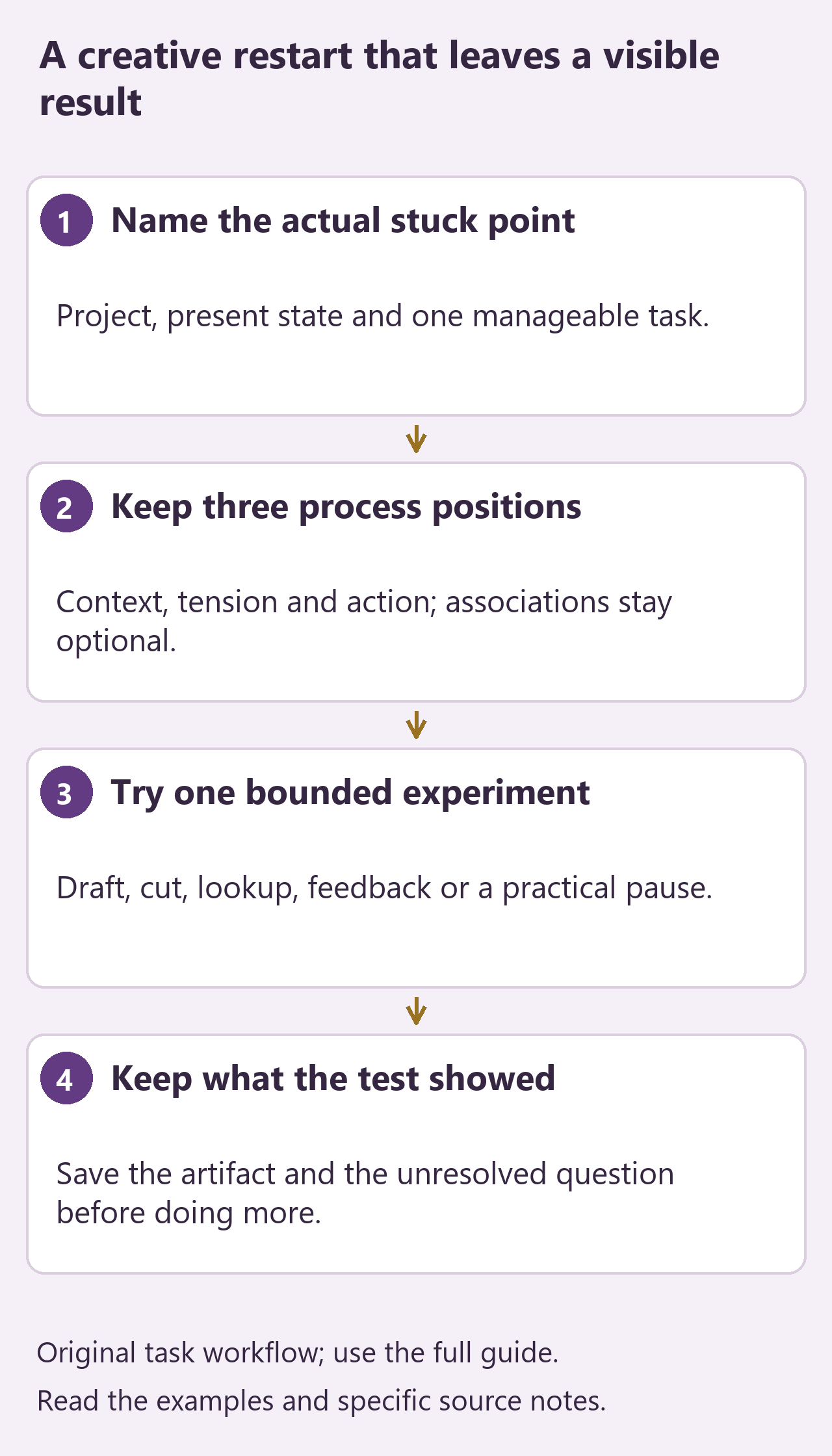
Examples to work through
These original examples show how to choose a proportionate task and keep actual information separate from an interpretation.
The card becomes a judgment of talent
A difficult image makes the writer conclude that they are not talented enough. The card does not measure skill. Return to the visible work: which sentence, sample or requirement needs attention? A small craft test or a pause is more specific than a judgment of the creator.
Too many ideas produce another long reading
The maker already has several options and starts adding cards to choose the best one. Instead, state a simple constraint and make one sample. Keep the result and what you learned. A short trial does not need to decide the project’s permanent direction.
The missing information is in the brief
The artist is unsure which size the client requested. Read the brief or ask the appropriate person. A card cannot verify dimensions. Once the requirement is known, a sketch can be judged against the actual task.
The test is bigger than the available time
A draft plan requires hours the creator does not have. Reduce the scope, arrange a realistic return point or pause. The action position does not override practical constraints. Record the actual limit rather than calling it a failure to follow the card.
Creative restart experiment
Use these optional reminders to mark fields you want to keep in your own notes. The downloadable blank sheet contains every record field. Keep your completed record in your own appropriate private place.
Frequently asked questions
Can a tarot spread remove creative block?
No guarantee is made. This exercise uses optional associations to propose a small test with the actual work. What the test produces can inform your next step; the spread does not diagnose or treat the cause of the block.
What should I ask before drawing?
Name the project, its present state and a manageable task. For example, “What small change could help me finish one opening draft?” Avoid using the cards to judge your talent or guarantee a project’s income or success.
How many cards does this exercise use?
Three, with Context / Tension / Action labels kept fixed. Cards can be deliberately selected for practice. You can also use the same questions without cards; the output is a small test, not a required draw.
What if the suggested action does not help?
Keep the result and describe what remained unclear. You can alter one constraint, check a missing requirement or pause. A mismatch is useful information; you do not need to reinterpret it as a hidden success.
Sources and what they support
- A. E. Waite: Eight of Pentacles
Supports the attributed description of an artist in stone at work and historical craft associations. The draft, revision and journal workflows on this page are original optional exercises, not instructions claimed from that chapter.
- A. E. Waite: Two of Pentacles
Supports the attributed dancing figure, two pentacles and endless cord, with varied historical associations. Modern task-planning prompts are labelled as original optional uses, not the entire historical account or evidence of present circumstances.
The worked scenarios and writing tasks are original illustrations, not reader interviews, measured benefits or predictions. Keep the actual card image, an identified source account and your own association separate. The sources support only the specific points described above; an interpretive example does not establish hidden facts or professional advice.