How to Interpret a Tarot Spread: Worked Examples
Revised · Tarot card study and optional reflection
Interpret a tarot spread by giving each card the job its position assigns, describing a relevant image or association, and connecting those position sentences. Then ask which parts fit the known situation and which remain assumptions. A coherent story is a proposal, not proof of a future event.
Write the question and positions first
A card list does not tell you the spread’s structure. “Situation / tension / possible response” and “past / present / future” assign different jobs even when they contain the same cards. Record the actual labels before looking up meanings. If no labels were assigned, say that you are reading an unassigned group; do not invent a past position after seeing an image.
For the worked example, use this low-stakes question: “How can I prepare a useful first draft for my project group?” Known facts: you have a rough outline, the group’s priorities are unclear, and feedback is available from one teammate. Use three positions: available resource, question to investigate and possible response. Select the Magician, Two of Swords and Three of Pentacles upright for practice.
These chosen practice cards illustrate three explicit position jobs. The circumstances are invented and stated before interpretation; the cards did not discover the outline, the uncertainty or the teammate.
Give each card one position sentence
Start with the image in the deck you actually have or a clearly identified source description. Separate that from your association. Then answer the position’s question using tentative wording. A card in “question to investigate” can prompt a question; it does not supply the missing answer.
On a narrow screen, scroll this table sideways to read all columns.
| Position and selected card | Chosen association | Position sentence and factual check |
|---|---|---|
| Available resource: The Magician | Tools and putting a skill to use. | I could turn the rough outline into a small demonstration. Check which parts are ready and understandable. |
| Question to investigate: Two of Swords | A choice that has not been made. | I need to clarify the group’s priority. Ask about the actual requirement; do not infer that somebody is hiding information. |
| Possible response: Three of Pentacles | Craft reviewed with other people. | I could request feedback on one section. Check who has time and what question would make the feedback useful. |
The associations are original choices for this exercise, not compulsory definitions for every deck. A proposed sentence can be rejected if it has no connection to the actual task. Write “this association does not help here” instead of forcing all the details into the story.
Connect the sentences without inventing facts
A summary might be: “Use the outline I have, clarify the priority I do not know, and get feedback on a small draft.” It joins the three position answers through a practical relationship. It does not need to say that a future colleague will arrive or that success is guaranteed.
Compare that with “The Magician says success, Two of Swords says blockage, and Three of Pentacles says teamwork.” That list has associations but no position jobs, known facts or checkable next step. Adding more keywords will not automatically supply the missing connection.
Use a short connector such as “while,” “because” or “if” only when you can explain the relationship. For instance, “I can revise the outline while I wait for the priority answer” proposes two compatible actions. “Because the Two of Swords proves the group is withholding information” invents a cause. The wording matters because a smooth sentence can hide an unsupported claim.
What if a card appears to contradict the others?
Read its position again. A resource can be available while a response needs a different approach. A cautious association and an energetic association can become a question about pace rather than cancelling each other. Contradiction is not automatically a mistake or a profound hidden message.
For an original contrast, imagine the Eight of Pentacles in “resource” and the Two of Pentacles in “possible response.” Craft practice might prompt a focused revision; the second card might prompt comparing two demands. Waite’s Eight describes a stone artist at work. His Two describes a dancing figure with two pentacles and an endless cord. Our focus-and-priorities connection is a modern optional association, not a documented prediction in those descriptions.
If the two demands do not actually exist, do not create them to fit the card. You might instead note that the association is irrelevant. A reading can remain partly unresolved.
Use patterns as prompts, not diagnoses
Counting suits, numbers or courts describes the selected group. It does not show that your life lacks a missing suit’s supposed quality. “There are two Pentacles cards here” is an observation. “I must have neglected practical life” needs evidence from your actual circumstances.
Likewise, a dramatic picture is not automatically the most important card. Read its assigned role, the surrounding position answers and your reaction. If an image makes the exercise distressing, pause; you do not owe it an interpretation. A reversal is another optional convention to record, not a reason to expect harm.
Resolve a question before drawing a clarifier
Name the uncertainty. If it is a card name, deck detail or unfamiliar source, look it up. If it is the project’s deadline or someone’s availability, seek ordinary information. Another card cannot confirm those facts. If it is a vague position, acknowledge that the spread was underspecified rather than rewriting its original role.
You can choose a different clearly labelled exercise later. The fixed-card position swap deliberately changes roles and keeps other conditions fixed; that is a comparison exercise, not a replacement for missing project information.
Finish the present reading with the best tentative summary you can support, an unresolved question and one proportionate action or pause. Use the complete reading log to preserve it. The three-card tool is optional for a new low-stakes practice, rather than a required next step after you have already drawn.
From spread positions to a tentative summary
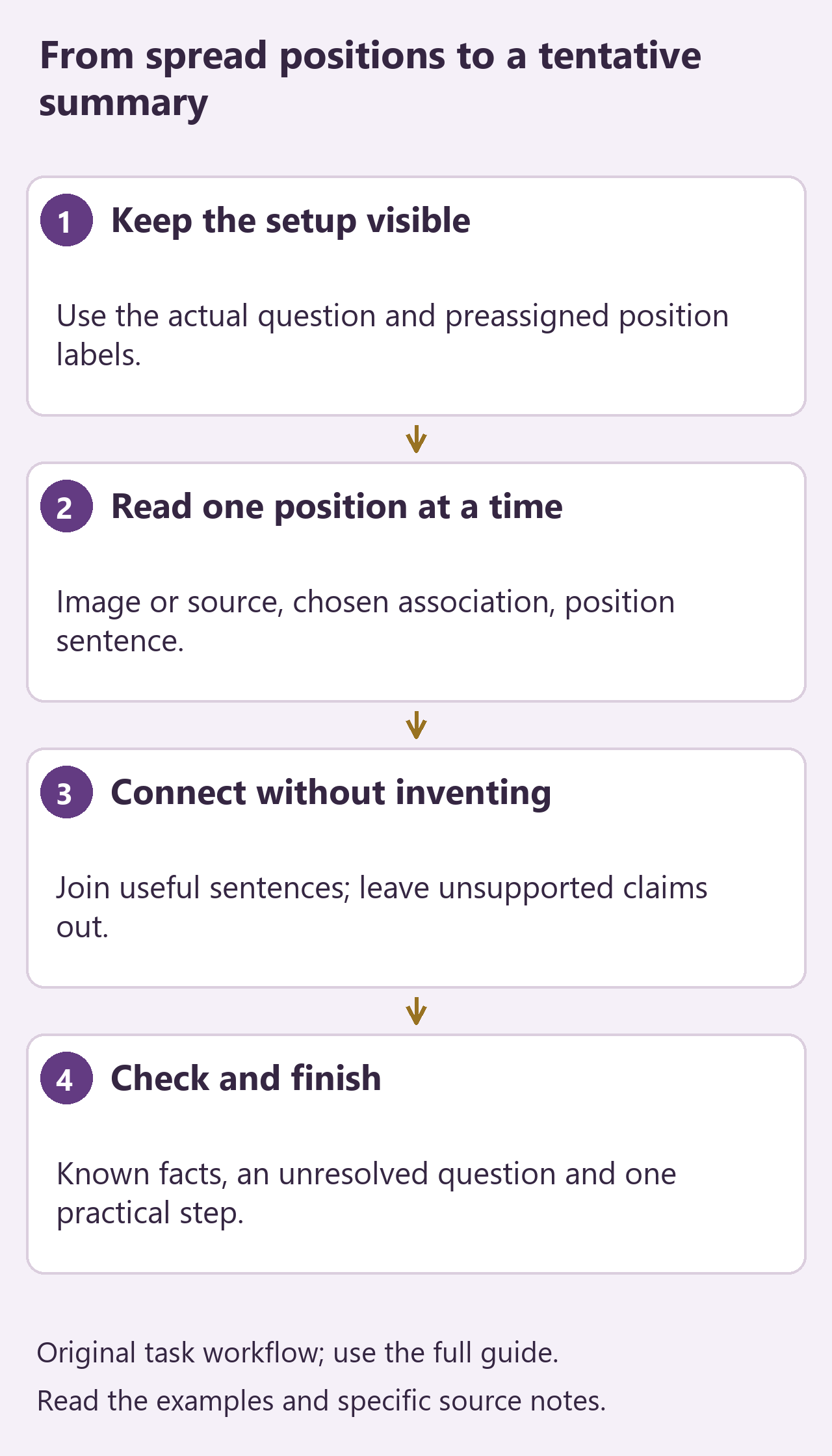
Examples to work through
These original examples show how to choose a proportionate task and keep actual information separate from an interpretation.
A difficult card draws all the attention
The reader ignores the resource and response positions because the middle picture feels alarming. Return to the middle position’s actual question, then read all three position sentences. The image’s emotional intensity does not establish its importance or predict a bad event. Pausing is also an available choice.
No Cups cards appear
A reader concludes that they lack emotion because the spread has no Cups. The selection only shows which cards appeared. If considering feelings helps the actual task, ask a voluntary question about them; do not present the missing suit as evidence of an emotional deficit.
The same card moves to another position
The Magician in resource prompts a look at available tools. In question-to-investigate it might prompt checking whether those tools fit the task. The changed prompt changes the interpretation’s job. It does not change the tools or establish an external event.
The missing answer is a deadline
A spread remains unclear because the project deadline is unknown. Ask the appropriate person or check the project brief. A clarifier cannot verify the deadline. Record what you know and what you still need, rather than drawing until one date sounds convincing.
Tarot spread synthesis worksheet
Use these optional reminders to mark fields you want to keep in your own notes. The downloadable blank sheet contains every record field. Keep your completed record in your own appropriate private place.
Frequently asked questions
What should I read first in a tarot spread?
Read the original question and position labels. Then consider the actual card image or an attributed meaning through each position’s job. Without that structure, say that the cards were unassigned.
How do I connect cards without forcing a story?
Write one tentative sentence per position, then connect only the relationships you can explain. Check the known facts separately. Leave an irrelevant association or uncertainty visible instead of inventing a cause.
Do repeated suits explain my situation?
They describe the cards in the spread. You may choose to use a suit association as a reflection prompt, but its count does not establish what is happening in your life or why. Actual circumstances need their own evidence.
Must I draw a clarifier when the spread is unclear?
No. First identify what is missing. A source lookup, a clearer future exercise, an ordinary factual question or a pause may address the uncertainty better. More cards do not verify an unknown real-world fact.
Sources and what they support
- A. E. Waite: Eight of Pentacles
Supports the attributed description of an artist in stone at work and historical craft associations. The draft, revision and journal workflows on this page are original optional exercises, not instructions claimed from that chapter.
- A. E. Waite: Two of Pentacles
Supports the attributed dancing figure, two pentacles and endless cord, with varied historical associations. Modern task-planning prompts are labelled as original optional uses, not the entire historical account or evidence of present circumstances.
The worked scenarios and writing tasks are original illustrations, not reader interviews, measured benefits or predictions. Keep the actual card image, an identified source account and your own association separate. The sources support only the specific points described above; an interpretive example does not establish hidden facts or professional advice.