Practice worksheet
Two-Card Tarot Spread Order: Position and Interpretation Examples
Two-card spread order matters when each position has a different job. A card in “what is available?” answers a different prompt from the same card in “what needs investigating?” Swapping the cards changes that relationship to the questions; it does not establish a different future. Keep the question and position labels fixed to compare the two readings fairly.
Separate position, sequence and reversal
| Change | What it means in this exercise | What to record |
|---|---|---|
| Exchange the cards between positions. | Each card is now considered through the other position's question. | Keep both position prompts unchanged. |
| Turn a card upside down. | You introduced a reversal, if your chosen reading convention uses one. | Record orientation separately from position. |
| Change “resource” to “obstacle.” | You changed the prompt, even if the cards did not move. | This is a new frame, rather than an order-only comparison. |
| Read two unassigned cards in a different sequence. | You changed the order in which you discuss them, without a fixed position job. | State that there are no assigned positions. |
There is no universal rule that the left card means the past or that the right card gives advice. A particular spread can assign those roles, but it needs to say so. If you use left-to-right placement, label the positions before drawing. If your layout runs vertically, numbers can keep the roles clear.
Position order also does not automatically describe time. “Resource” and “question to investigate” are two roles in the same reflection, not necessarily two events happening one after another. Do not add “then this will happen” just because you read the second card after the first.
Try a controlled swap with two fixed questions
Use this low-stakes question: “What can help me prepare a short beginner workshop?” Position 1 asks, “What resource is available?” Position 2 asks, “What needs investigating?” Both questions stay the same throughout the exercise.
For practice, deliberately select the Magician and the Hermit. This is not a new random draw or a forecast. Keep both cards upright, read Run A, exchange their positions and read Run B. You are studying how a position prompt directs attention.
Download the original position-swap diagram
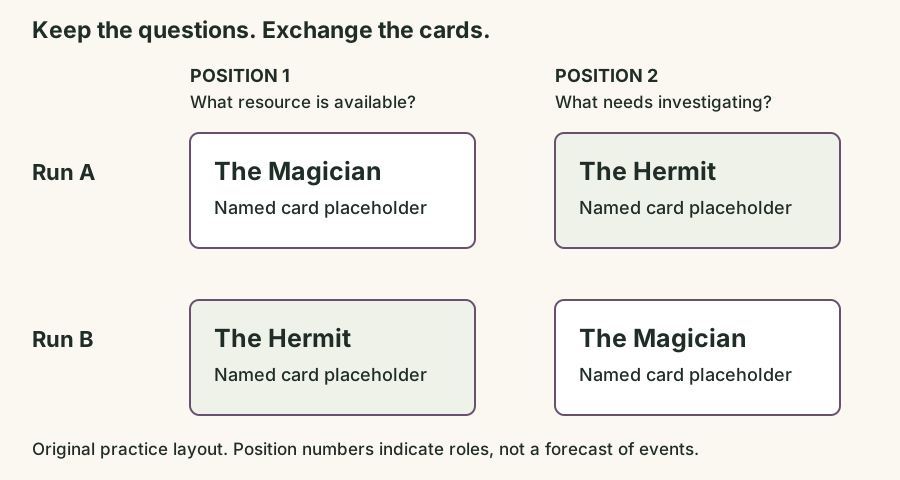
Before interpreting, write two real facts about your task. In this illustrative workshop, imagine that you already have a simple demonstration and some notes, while the participants' experience is unknown. Those are stated scenario facts, rather than information discovered by the cards.
Distinguish historical description from modern prompts
In A. E. Waite's The Pictorial Key to the Tarot, the Magician's table holds the symbols of the four suits. Waite describes the figure adapting them as he wills, within a wider spiritual explanation. For this exercise, we develop an original practical prompt about tools, skills and using available resources. That workshop interpretation is not a quotation from Waite.
Waite describes a star shining in the Hermit's lantern and a raised beacon associated with attainment. He explicitly rejects some interpretations, including a simple wise-man-searching-for-truth account and occult isolation. Here we use the beacon as a modern prompt about guidance, recorded knowledge and what can illuminate a question. Do not attribute “the Hermit always means being alone” to the cited passage.
Historical reading methods also give positions distinct jobs. In Waite's Celtic method, the first covering card concerns the general influence, while the second crossing card concerns obstacles. That is evidence of a documented position-based method, not evidence that the two-position workshop spread here is ancient or that its interpretations predict outcomes.
The modern exercise uses only the distinction between image and position. It does not adopt the historical method's predictions, demographic card assignments or repeated readings for an uncertain result.
Worked comparison: what changes in each position?
| Run and position | Card | One possible reflection | A real-world check |
|---|---|---|---|
| A, 1: available resource | The Magician | My existing demonstration and tools may provide a concrete starting point. | List what is ready and test whether it works. |
| A, 2: needs investigating | The Hermit | I need guidance on what beginners will find confusing. | Ask a potential participant or review relevant feedback. |
| B, 1: available resource | The Hermit | My notes and any relevant guidance may help organize the workshop. | Identify which note or adviser actually answers this task. |
| B, 2: needs investigating | The Magician | I need to check how well my skills and tools translate into a beginner demonstration. | Try explaining one step without assumed vocabulary. |
Run A emphasizes ready materials, then missing guidance about the audience. Run B emphasizes available guidance, then testing the demonstration itself. The cards have not gained new factual powers. The assigned questions have made different aspects relevant.
A combined sentence for Run A could be: “Start with the demonstration I already have, while checking what this audience needs.” For Run B: “Use my notes to structure preparation, while testing whether the demonstration is clear.” Both can be useful hypotheses. The records and feedback determine whether they fit the actual workshop.
If no relevant guidance or ready demonstration exists, do not invent one to match the card. Write “I do not currently have this resource” and decide whether finding it would be useful. A card image can suggest a question without making the answer true.
Three practice contrasts with explanations
The same named cards appear in these original practice scenarios. Work out what was changed before opening the explanation. These questions assess the reading method, not the accuracy of a prediction.
Case 1
You move the Hermit from “available resource” to “needs investigating” and say, “I can use relevant guidance” becomes “I need to find relevant guidance.” What changed, and what still needs evidence?
Show answer and explanation for case 1
The position prompt changed which aspect of guidance you considered. Whether guidance is available, relevant or missing still needs a real check.
An exchanged position can shift the reflective question without establishing a fact. Identify the actual document, person or unanswered question rather than treating the card as proof of access or lack.
Case 2
For “first approach / what needs balancing,” one run puts the Magician first and the Hermit second. You swap the cards and read “begin with guidance, then check implementation.” Is this a time prediction?
Show answer and explanation for case 2
No. You are comparing two possible emphases under a chosen approach-and-balance frame. Any planned sequence is your proposal.
In one run, implementation may need more guidance; in the other, guidance may need a practical test. Neither frame says events will unfold that way. This frame also differs from the resource/investigation spread, so record it separately.
Case 3
You assign “Option A / Option B,” put the Magician on A and the Hermit on B, then announce that A will succeed. Would swapping the cards fairly reverse the decision?
Show answer and explanation for case 3
No. A named card is not a success score, and moving it cannot settle which option is better. Compare the options using the same factual criteria.
The images might prompt questions about implementation and guidance for either option. Time, cost, suitability and the people affected remain real decision criteria. If the interpretation changes only which option receives praise, check whether you have replaced comparison with a preferred story.
A printable same-cards, different-positions record
| Record item | Run A | Run B: cards exchanged |
|---|---|---|
| Main question | ________________ | Same question: ________________ |
| Position 1 prompt | ________________ | Same prompt: ________________ |
| Position 2 prompt | ________________ | Same prompt: ________________ |
| Card in position 1; orientation | ________________ | ________________ |
| Card in position 2; orientation | ________________ | ________________ |
| One sentence for position 1 | ________________ | ________________ |
| One sentence for position 2 | ________________ | ________________ |
| What the images made me notice | ________________ | ________________ |
| Which actual fact supports or challenges it? | ________________ | ________________ |
Compare the two records
- Which emphasis changed because a card answered the other prompt?
- Which detail stayed similar because both readings used the same image?
- Did I change a prompt, an orientation or a scenario fact accidentally?
- What useful question remains if I remove the card names?
- What can I check without drawing again?
My comparison:
One grounded next step:
You do not have to force a dramatic difference. Two images can overlap under some prompts, and a short record may reveal that your interpretations remain broad. Make the position questions more precise for a future exercise, or acknowledge that the swap added little.
Keep the experiment separate from another reading
Finish both runs with the same selected cards. Drawing replacements, changing the main question or adding reversals introduces another variable. That may be a different practice, but it will no longer show what the position swap alone did.
Do not exchange the cards repeatedly until one arrangement gives the reassurance you want. The exercise is complete when you can explain the role change and identify what needs a factual check. If the process increases worry or pressure to obtain a certain message, stop and return to ordinary information and support.
For everyday reflection, a useful result might be a clearer workshop question or a small test of your explanation. Cards cannot verify another person's thoughts, diagnose a condition or decide a high-stakes matter. Keep actual evidence, consent and suitable professional guidance central to those decisions.
The skill to carry into another spread is simple: identify each position's job, consider the card through that job, then distinguish the resulting idea from what you know. Order becomes useful when it clarifies your questions, rather than turning an image into an authority.
Sources and further reading
- A. E. Waite, The Pictorial Key to the Tarot: I. The MagicianHistorical table and suit-symbol description within Waite’s spiritual commentary. Workshop tools-and-skills prompts here are modern, original adaptations.
- A. E. Waite, The Pictorial Key to the Tarot: IX. The HermitHistorical star-in-lantern, beacon and attainment commentary, including interpretations Waite rejects. The guidance questions here are not presented as quotations or a universal meaning.
- A. E. Waite, The Pictorial Key to the Tarot: the Celtic methodA documented method assigns different roles to covering and crossing positions. It does not establish an ancient origin or predictive validity for this original two-card exercise.