Shadow Work Tarot Prompts: Gentle Questions
Revised · Tarot card study and optional reflection
Use a shadow work tarot prompt as an optional question about a reaction you already notice, not a test for hidden wounds. Keep the subject ordinary and manageable, separate facts from guesses, and finish with a small response or a pause. You can answer the questions without drawing cards.
Choose a present-day question you can leave unfinished
This guide uses “shadow work” for voluntary reflection on reactions, judgments or habits you would like to understand. It is not a diagnostic method, trauma treatment or a way to uncover a concealed memory. No particular card proves why you feel something. You do not need to disclose painful experiences to complete a prompt.
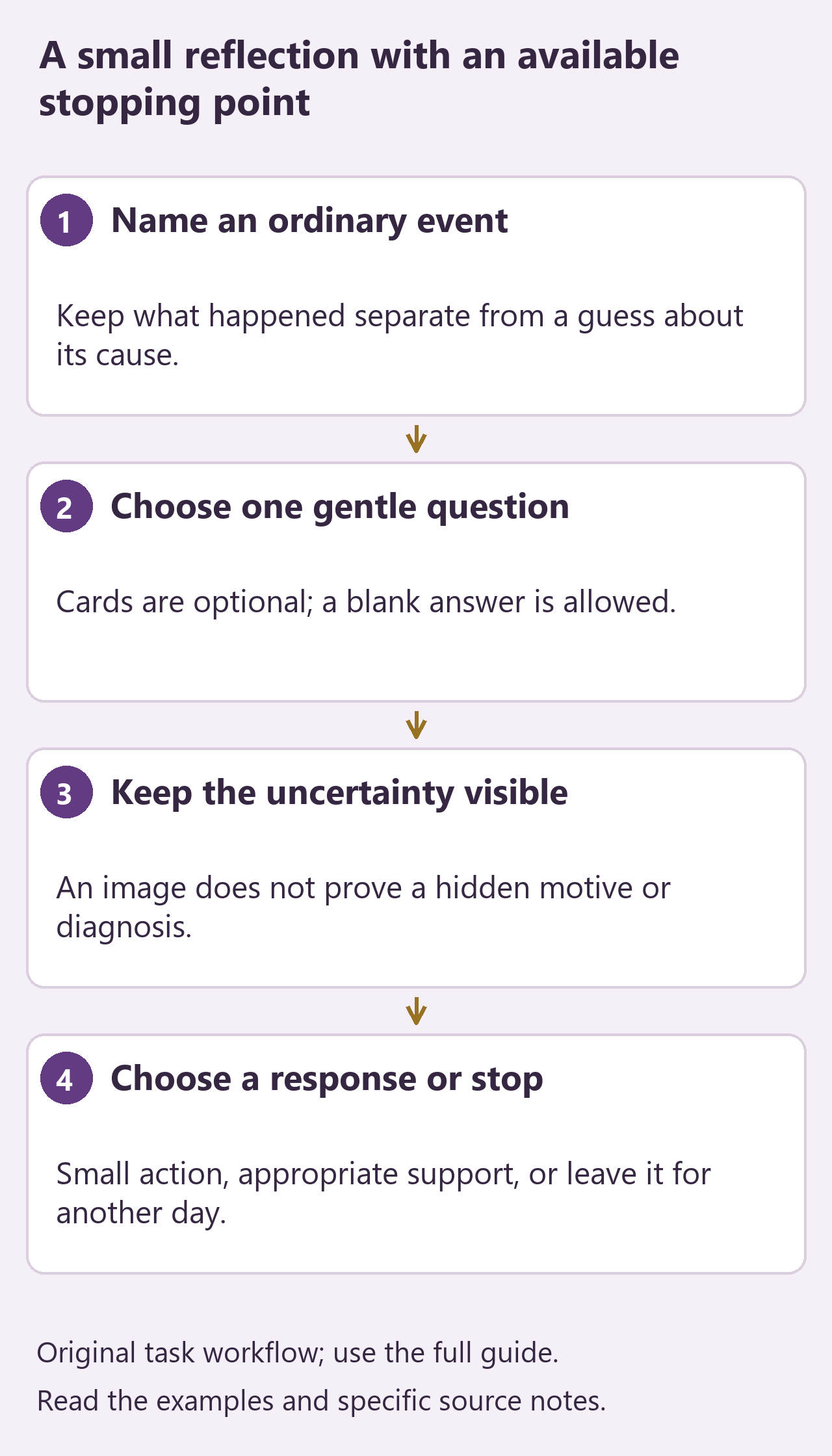
Start with one recent, ordinary event: you postponed a small task, felt annoyed by a late file or said yes when you wanted time to think. Write what happened before naming a cause. “The file arrived after the agreed time” describes an event. “They disrespect me” is an interpretation that may require more information.
Choose a subject you feel able to put down. You may skip any question, use no cards or stop immediately. A brief time limit can make the exercise easier to contain; it is a personal choice, not a therapeutic dose. The purpose is a clearer note about your own response, not a compulsory emotional breakthrough.
Twelve gentle prompts, grouped by task
On a narrow screen, scroll this table sideways to read all columns.
| Task | Questions you can choose | A small way to finish |
|---|---|---|
| Name the reaction | What happened, using observable words? What feeling can I name without explaining it away? Which part is a guess about somebody else? | Keep one event and one feeling in separate sentences. |
| Consider alternatives | What else might explain the event? What information is missing? Am I asking a card to answer a question only another person or a record could answer? | Write one uncertainty rather than choosing a hidden cause. |
| Clarify a preference or boundary | What would I prefer next time? What request can I make clearly? Which decision can I leave until I have more information? | Draft a request or a pause in ordinary language. |
| Choose a proportionate response | What small action belongs to me? What support would help? Would leaving this question alone be kinder today? | Choose an action, support request or deliberate stop. |
These questions are original reflection prompts. Their value does not depend on drawing a difficult card, identifying a “shadow” trait or agreeing with a particular psychological theory. A blank answer is allowed.
A worked example without a hidden-cause claim
Imagine you received a teammate’s file late and sent an abrupt reply. The actual facts are the agreed handoff time, the later arrival and the words you sent. You feel irritated. You do not know why the file was late or how the teammate interpreted your reply.
If you want an image prompt, deliberately select the Moon and write, “I associate this image with uncertainty.” That is your chosen association, not proof of deception or a hidden wound. It might help you ask what is still unknown; it cannot establish the answer.
A short note could be: “The handoff was late and I replied sharply. I wanted enough time to check the file. I do not know the cause of the delay. I can ask for earlier notice next time and rewrite my request without making a claim about their character.” Any apology or conversation should fit the actual circumstances, rather than follow a card as a command.
The same prompt could produce a different conclusion: perhaps the deadline was never clear, or you prefer to wait before responding. Keep that possibility visible. Reflection should not erase a real boundary or require accepting harmful behavior.
If you use three cards, keep three explicit jobs
For a paper exercise, label the positions before selecting cards: reaction I already notice, alternative question and response I choose. The first position reflects your stated reaction; it does not diagnose it. The second asks what remains uncertain; it does not reveal someone’s motives. The third suggests a possible response for you to assess using real information.
The site’s three-card tool offers preset spread labels. If you use it, record the selected labels exactly instead of treating its positions as a custom layout. You can use its Context / Tension / Action frame for a separate low-stakes reflection, but the tool is optional. One question on paper is enough.
Keep care and support separate from the card
NIMH describes self-care as individual and emphasizes ordinary priorities, enjoyable activities, connection and appropriate professional support. That information does not endorse tarot or demonstrate a benefit from these prompts. Choose a familiar activity or human support because it suits your circumstances, not because an image supposedly diagnoses what you need.
If the exercise increases distress, self-criticism or pressure to uncover something, stop. Do not keep drawing in an attempt to force a better answer. Persistent or severe distress is a reason to seek qualified help; urgent danger needs urgent local support rather than another prompt. You need not wait for a journal entry to justify getting help.
End by keeping one event, one reaction and one choice in a private note, or by leaving the page. A useful finish can be “I am not ready to explore this.” For a lighter daily question, use the daily prompt library; for a complete spread record, use the reading log.
A small reflection with an available stopping point
Examples to work through
These original examples show how to choose a proportionate task and keep actual information separate from an interpretation.
A difficult card becomes a label for the reader
The reader draws the Devil and concludes, “I am a bad person.” The card does not establish that judgment. Set it aside, write the actual event if you want to, and choose a proportionate response or stop. No prompt requires self-attack.
The prompt starts investigating another person
A late reply becomes a question about someone else’s hidden motive. Keep the delay as a known event and its cause as unknown. An appropriate factual question or boundary can be considered separately; a card cannot settle what the other person intended.
The reader does not want to answer
A question brings up more than the reader wants to discuss. Skip it or finish with “not today.” There is no requirement to disclose, push through discomfort or add clarifiers. Suitable human support can be sought without completing the exercise.
Reflection starts excusing a harmful action
The reader decides that understanding their own reaction means tolerating someone’s harmful behavior. Those are different questions. An optional prompt should not erase a factual boundary or replace appropriate safety support.
Gentle reflection note
Use these optional reminders to mark fields you want to keep in your own notes. The downloadable blank sheet contains every record field. Keep your completed record in your own appropriate private place.
Frequently asked questions
Can shadow work tarot diagnose a hidden problem?
No. These prompts are optional questions about reactions you already notice. A card does not diagnose a condition, explain a hidden cause or recover a memory. Actual concerns need appropriate information and, where relevant, qualified help.
Do I need to draw several cards?
No. You can answer one question without cards. If you choose a spread, label each position before selecting cards and keep its interpretation tentative. More cards do not make a personal explanation true.
What if a prompt makes me feel worse?
Stop or skip it. You do not owe the exercise an answer. Use familiar support that fits your circumstances; seek qualified help for persistent or severe distress and urgent local support for immediate danger.
Is this a substitute for therapy or trauma treatment?
No. It is a voluntary writing exercise and has no diagnostic or treatment protocol. It does not require exposure, disclosure or an emotional breakthrough, and no therapeutic benefit is claimed.
Sources and what they support
- NIMH: Caring for Your Mental Health
Supports general discussion of individual needs, priorities, enjoyable activities, support and appropriate professional help. NIMH does not endorse tarot, this prompt library or a treatment method based on cards.
The worked scenarios and writing tasks are original illustrations, not reader interviews, measured benefits or predictions. Keep the actual card image, an identified source account and your own association separate. The sources support only the specific points described above; an interpretive example does not establish hidden facts or professional advice.