Practical guide
Two Tarot Readers, Different Interpretations: A Fair Comparison
Keep the image, position and question the same, write separate notes before discussing them, then compare visible details, chosen associations and proposed actions separately. Correct an observable mistake; explain a difference in interpretation without declaring a winner.
Decide what you are comparing before either person writes
“We read the same card differently” can mean several things. One person noticed a detail the other missed, both chose different associations, or they quietly answered different questions. A comparison is easier to understand when those differences are visible. It is not a test of whose future prediction is correct.
Agree on one low-stakes task, the same visible image and the exact position label. If you use a deck, record its edition; a shared card name does not guarantee shared artwork. Decide whether an identified guidebook passage is available to both readers or whether this round begins without it. Do not give one person a source and call the resulting difference a difference in intuition.
This exercise compares two people while holding the task fixed. The two-card position exercise instead changes a card’s assigned position. The before-and-after guidebook exercise changes source exposure. Choose the comparison that answers your actual question. [1] [2]
Write a short independent note before discussion
Each person writes four lines: what is visibly present, what they associate with it, a tentative answer to the agreed prompt and one uncertainty. Complete those lines separately before sharing. This procedure keeps each first note available for comparison; it does not demonstrate that a pair reached an unbiased or more accurate answer.
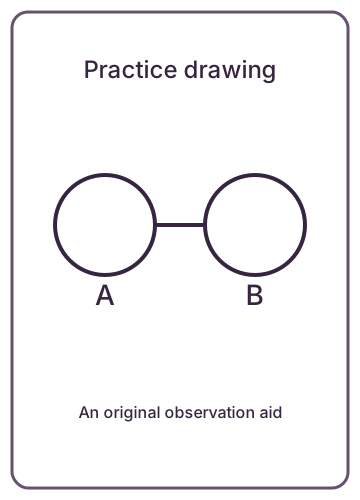
Keep observation specific. “Two circles joined by a line” describes an image. “Cooperation” is an association. “My colleague will help me” makes a claim about another person that the image cannot establish. A sentence can be fluent and still move between those categories without warning.
Agree that either person can leave a line blank, choose a fictional example or stop. A partner need not disclose a personal difficulty to supply interesting material. Keep consent and privacy ordinary and practical: ask before sharing their note, and remove names or identifying details from a public worksheet.
A complete comparison with one original practice image
The diagram below was made for this guide. It is not historical tarot artwork and has no assigned traditional meaning. Both fictional readers receive the same position, possible next scene, and task: “What small action could open a fictional scene?” No real person, reading session or observed outcome is being reported.
| Field | Reader A | Reader B |
|---|---|---|
| Visible detail | Two equal circles, A and B, with a line joining them inside a rectangle. | Two equal circles, A and B, with a line joining them inside a rectangle. |
| Chosen association | A route between two places; a delivery that connects them. | A shared boundary or agreement between two people. |
| Tentative next scene | A courier asks where to leave a parcel before crossing a bridge. | Two neighbours mark a shared work area before building anything. |
| What remains invented or unknown | There is no courier, parcel or bridge drawn. I chose those story elements. | There are no neighbours or work tools drawn. I chose those story elements. |
| Check against the task | One small action opens a scene: asking for a delivery location. | One small action opens a scene: marking an agreed space. |
Both notes answer the same creative prompt. Neither association is a fact about what the line “really” means. They propose different scenes from the same visible material. You can choose the scene that fits your draft, combine an element with an explicit rewrite, or keep both possibilities. A preference for one story does not prove the other person misread the diagram.
Which differences can you actually correct?
Now add a third, deliberately faulty note: “There are three circles and an arrow pointing from A to B.” The image contains two circles and a line without an arrowhead. That observation can be corrected by looking at the diagram. “A could send something to B” remains an optional invented action; the absence of an arrow does not forbid a writer from inventing it.
| Statement | What kind of statement is it? | Appropriate response |
|---|---|---|
| “There are three circles.” | An observable image claim. | Recount the circles together; correct the first note visibly. |
| “The line suggests a bridge to me.” | A personal association. | Ask which detail prompted it; label the bridge as invented. |
| “This means your neighbour is hiding something.” | An unsupported claim about a real person. | Remove the assertion; seek real information if relevant. |
| “In the guidebook this card has this phrase.” | A claim about an identified source. | Check the exact edition and passage; keep quotation and paraphrase distinct. |
| “My scene works better for this particular draft.” | An editorial judgment. | State the draft’s criteria, such as continuity or a clear opening action. |
Disagreement about a guidebook passage can have a checkable answer. Disagreement about which fictional scene you prefer may remain open. Avoid using a historical source as an authority for a plot, emotion or other person’s private intention that the source cannot verify.
Discuss the notes without turning the exercise into a contest
- Read each original observation first. Check the shared image or named source where necessary.
- Ask each reader which detail led to their association. A missing connection can be recorded without forcing an explanation.
- Compare how the proposed sentence answers the fixed position and prompt.
- Mark introduced fictional details and unsupported real-world claims.
- Write one usable revision or leave an unresolved difference.
Do not score a person’s intuition from whether you like their scene. If one person knows the task’s real circumstances and the other does not, state that difference. Their notes are responding to different information. If both consult a guidebook afterward, save a dated second version rather than replacing the independent first notes.
For a real planning question, the next step might be checking a deadline or asking a person a clear question. Agreement between two interpretations does not supply the missing fact. This site’s methodology sets out its reflection and entertainment scope. [3]
Save a comparison that someone else can understand
Download the plain-text two-reader comparison record. It asks for the common setup, separate first notes, checkable corrections and remaining disagreements. It is a file to use locally, not an online account or a submission to this site.
A completed conclusion for the invented example is: “Both readers correctly described two circles and a connecting line. A proposed delivery scene; B proposed negotiating a shared space. We chose A’s opening because the existing story already has a courier. B’s version remains a possible scene for another draft. The diagram did not reveal a real event.” That conclusion explains the choice without inventing evidence.
If a comparison becomes uncomfortable, finish with “we interpreted this differently” and stop. A productive record can preserve a disagreement; it does not require an additional card, a persuasive winner or a personal disclosure.
Sources and further reading
- Tarot Tools: Two-Card Tarot Spread OrderRead the complete current guide. Supports keeping position jobs explicit; this two-person protocol and all scenes are original.
- Tarot Tools: Before and After the GuidebookRead the complete current guide. Provides the separate source-exposure comparison; it does not establish a benefit or accuracy score for paired reading.
- Tarot Tools: MethodologyRead the complete current policy. Cited for the site’s reflection and entertainment scope, not as evidence of a particular tool’s randomness or storage implementation.