Practical guide
High Priestess TORA Scroll and B/J Pillars
Waite names the scroll word Tora and links its covering to what is implied or spoken. The shown Smith scan places B left and J right from the observer’s view. Check those details and their attributed explanation.
What does the scroll say in the named source?
Waite’s Part II High Priestess chapter names the word Tora. He interprets it as the Greater Law, the Secret Law and the second sense of the Word. Those phrases belong to his esoteric account of the design. They are not, by themselves, a complete translation or explanation of a religious tradition.
Keep the spelling of an author’s wording distinct from a larger claim. A note reporting this passage should say that Waite uses Tora. Do not silently change his word inside a quotation, or infer that a differently printed scroll is an error without identifying that deck and its source.
The historical scan below is small. Its lettering is part of a partly covered rolled object; the named word is corroborated here by the author’s text rather than claimed as a new, high-resolution transcription of every visible letter.
Source: [1].
Inspect the identified illustration and the two pillar positions
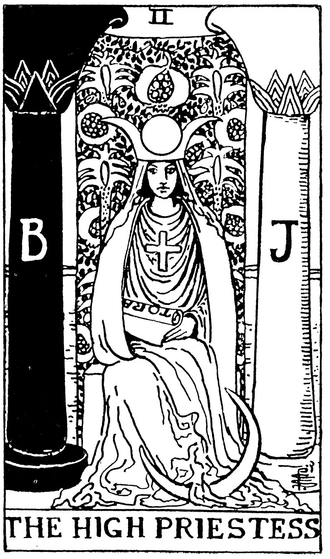
On a phone, scroll inside the table. Keyboard users can focus the table region and use the arrow keys.
| Feature | Where it appears | What not to infer from this scan alone |
|---|---|---|
| B pillar | Observer’s left; dark pillar with a pale B. | The seated figure’s own left is a different orientation. |
| J pillar | Observer’s right; pale pillar with a dark J. | A universal position in every later deck. |
| Scroll | Across the seated figure’s lap, partly covered by fabric. | A complete exposed text or precise reading of tiny obscured letters. |
| Veil | Behind the figure, between the pillars, with botanical motifs. | A literal pool of water visible behind the figure. |
| Crescent | Near the feet. | A new astronomical phase measurement or universal color meaning. |
Source: [3].
Use the observer’s view when writing an image caption. That avoids an ambiguous instruction such as ‘B is on her left’. If you compare another deck, start a fresh observation row for that deck rather than treating this caption as its description.
Why is the scroll partly covered?
Waite explicitly connects the mantle’s covering with some things being implied and some spoken. His explanation concerns the way the symbol presents knowledge. It does not identify a secret message from a real person, prove that someone is withholding information, or license a claim about private motives.
A short source note can read: ‘The scroll is partly covered. Waite explains the covering as a distinction between the implied and the spoken.’ If you then use it for reflection, make the shift explicit: ‘For my own notes, I will separate what was actually said from what I inferred.’ The second sentence is your present exercise, not an additional historical fact.
The chapter also names white and black J and B pillars of the mystic Temple. It does not expand those initials in the selected description. A fuller claim about named biblical pillars or a particular religious interpretation should cite the relevant text separately instead of treating the illustration alone as proof.
Source: [1].
Keep the veil, crescent and crown distinct
The author names palms and pomegranates on the veil, a lunar crescent at the feet, a horned diadem with a globe, and a cross on the breast. The inspected line-art scan helps locate these features, but it does not establish the colors of a particular color printing.
Waite continues into a spiritual interpretation using terms including Shekinah, Binah and Malkuth. If you study that account, attribute it to him and keep its context. A tarot caption that says ‘this represents intuition’ is a modern summary, not a full rendering of those religious and esoteric terms.
For a practical image record, write the feature first, the source explanation second, and any added association third. ‘Botanical pattern behind the figure’ is an observation; ‘Waite calls the veil’s motifs palms and pomegranates’ is a text-supported identification; ‘I associate the pattern with growth’ is your added association.
Source: [1].
Repair three complete image captions
These captions are fictional examples for source checking, not reader reports.
Case 1
A caption for the scan above says: “J is on the observer’s left dark pillar.” How should it be repaired?
Show answer and explanation for case 1
Change it to: “B is on the observer’s left dark pillar; J is on the right pale pillar.”
The inspected illustration supplies those positions. Adding “observer’s” avoids confusing picture left with the seated figure’s own left. The repair does not impose that arrangement on an uninspected deck.
Case 2
An invented note reads: “The partly hidden scroll proves my colleague is keeping a secret.” What can the pictured feature and named chapter establish?
Show answer and explanation for case 2
They establish a partly covered scroll and Waite’s implied-versus-spoken explanation, not a fact about the colleague. Repair the note to record the feature and separately label any reflection question.
The interpretation changes category when it claims knowledge of a real person. A useful optional exercise is to list what was actually communicated and what remains an inference; it is not evidence supplied by the card.
Case 3
A comparison caption says: “Every High Priestess card has these pillar letters, colors and scroll spelling.” Does this one scan establish that?
Show answer and explanation for case 3
No. Repair it to name this Smith illustration and its file record, and record the other deck’s actual visible details separately.
One identified design cannot establish all versions. This reproduction is black-and-white, and its listed 1911 image source is separate from the 1922 text transcription. Those facts should stay in the comparison record.
Use a filled edition-aware record
Filled example: image and text kept separate
Image: Smith High Priestess file record, creation date listed 1910, source listed Pictorial Key (1911), black-and-white 330 × 559 scan. Observations: B on observer-left dark pillar; J on observer-right pale pillar; partly covered scroll across lap; patterned veil and crescent near feet. Text: Waite’s Part II chapter in the cited 1922 Rider reprint transcription names Tora and explains implied versus spoken. Added association: for an optional journal exercise, I will mark statements versus inferences. Unknown: the details and guidebook explanation of any uninspected later deck.
For a second deck, record its title, publisher or artist credit and the exact card you inspected. Then add its scroll wording, pillar arrangement, veil and other changes that are actually visible. A simplified or redesigned picture may omit a feature; describe that difference before deciding what meaning to assign it.
Use the named-version comparison guide to compare identified designs. Use the general High Priestess meaning page for reflective reading contexts. A study caption should help a reader find and check the design, with your own association clearly labelled.
Sources and further reading
- A. E. Waite, The Pictorial Key to the Tarot, Part IIComplete named High Priestess chapter actually read. Wikisource transcribes the 1922 Rider reprint; quoted interpretations are Waite’s claims in this chapter, not universal deck rules. Checked November 11, 2026.
- Title, illustrator credit and publication history of the 1922 Rider reprintTitle names A. E. Waite, 78 designs by Pamela Colman Smith; printed publication statement says First Published 1910, Reprinted 1922. This is not a physically inspected first-edition copy.
- Pamela Colman Smith: High Priestess illustration file recordActually inspected black-and-white 330x559 original image. Record lists creation 1910, a 1911 Pictorial Key source and 2023 digital upload; marks Public Domain Mark 1.0. These image-record dates are separate from the 1922 text used here.
